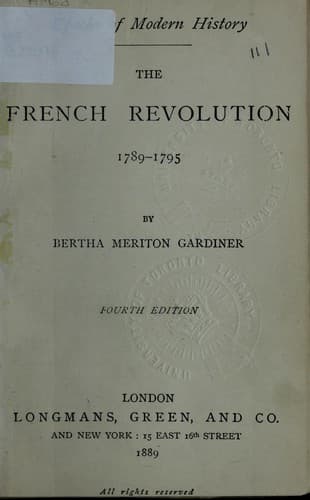
The French Revolution 1789-1795Gardiner, Bertha Meriton
History
The French Revolution 1789-1795
Gardiner, Bertha Meriton
France -- History -- Revolution, 1789-1799
The existence of feudal rights produced three results exceedingly
detrimental to the national prosperity. It impeded a good cultivation
of the soil; it prevented the country from being inhabited by men
of the middle class, who preferred to reside in towns rather than
recognise the social superiority claimed by the seigneur; and,
finally, it was an incessant source of irritation to the whole rural
population. By the rights due to a seigneur as ruler, and by those
of servile origin, all dwellers upon the fief were affected, whether
occupiers of land or not. The cultivator suffered at every turn--in
the prohibition to plant what crops he pleased; in the prohibition
to destroy the seigneur’s deer and rabbits that roamed at will over
his fields and devoured his green corn; in the toll he paid for leave
to guard his crops while growing, and to sell them after they were
gathered in; and in many other ways. Such a system had become in the
course of centuries both excessively complicated and wholly unsuited to
existing social conditions. Sometimes half-a-dozen different persons
claimed dues from the same piece of land. The proprietorship of fiefs
and the ownership of feudal rights, or the greater part of them, were
constantly separated. Poverty induced the resident seigneur to sell his
rights, which, bought by a townsman, passed from hand to hand in the
market, like any other property, and were the more sought after because
their possession was held a sign of social superiority. Non-resident
owners farmed them, and middle-men were harsh and exacting in their
collection. The peasant, ignorant and poor, but thrifty and cunning,
and fondly attached to his plot of ground, disputed claims made upon
him to pay dues now to this man, now to that, in virtue of concessions
of which, in a vast number of cases, the origin was completely lost.
Innumerable lawsuits resulted, which left stored up in the peasant’s
mind bitter feelings of resentment against both judge and seigneur, one
of whom he accused of partiality, the other of rapacity and extortion.
♦The Church.♦
Public-domain text, read in full here on John Shaqi.
Reviews
Reviews
No reviews yet
Be the first to share your thoughts on this work.
Join the Discussion
Join the discussion
Sign in to leave a comment or review.
Sign InorCreate an account