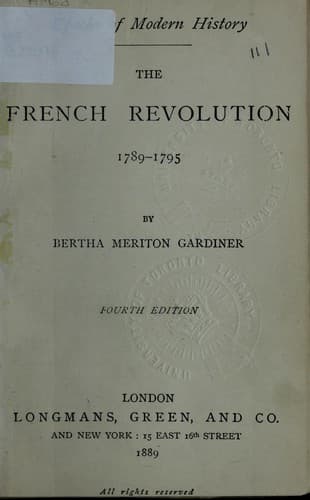
The French Revolution 1789-1795Gardiner, Bertha Meriton
History
The French Revolution 1789-1795
Gardiner, Bertha Meriton
France -- History -- Revolution, 1789-1799
inscribed their names as members.
♦Fall of Hébertists and Dantonists.♦
Robespierre, as his habit was before he was sure of his path, adopted
an undecided attitude between the Hébertists and the Dantonists,
blaming the extreme, whether of excess or of moderation. The Hébertists
sought to strengthen their position in the club by attacking the
Dantonists; and it was only owing to Robespierre’s protection that
Desmoulins and others who had demanded the adoption of a more clement
policy, were able to maintain their footing in the society. Finally,
Robespierre secured his end by abandoning the Dantonists as victims to
the fanaticism and cruelty of his followers, whilst he openly sought
the proscription of the Hébertists. One after another, persons who had
either professed atheism or had displayed feelings of humanity, were
deprived of membership. The club became the tool of the Committee of
Public Safety, and none but the satellites of Robespierre and Collot
breathed freely in it. The Dantonists had no support to which to look
but the feeble and disunited Mountain. No one trusted his neighbour,
and each dreaded to oppose the will of the two committees, lest he
should afterwards be abandoned to their vengeance. Although the
Hébertists appeared more formidable, the danger of their being able
to overpower their adversaries was small. They could no longer rely
for support on the forces which had been at their disposal in July and
August. After the passing of the maximum laws they had played their
last card, and had no means left by which to move the populace to take
their side. On the contrary, it had become a constant effort on the
part of the Commune to prevent the gathering together of hungry crowds
in the streets, which might lead to a perfectly genuine explosion of
popular fury directed against itself. Every vestige of free political
life had been stamped out. The general assemblies of the sections only
met twice a week, and those attending them were paid. Clubs to which
many members belonged were viewed with suspicion and discountenanced.
The great maximum law of September, fixing prices at a third above what
they were in 1790, had ruined so many persons that it was abandoned as
untenable. A new law took as a basis the real cost of each article in
the place of production, allowed a certain percentage for carriage,
ten per cent. for the wholesale, and five per cent. for the retail
dealer. The tariff for Paris, which was published in March, excited
great discontent. Of the needier supporters of the Commune many had now
acquired booty or office, and hesitated to risk their lives by taking
up the cause of Hébert against Robespierre. The Committee of Public
Safety bid for the support of the idle and hungry by two laws, the one
(February 26) ordering the sequestration of property belonging to the
enemies of the revolution, the second (March 3) promising that means
should be taken to make provision for destitute patriots out of the
sequestered property.
Public-domain text, read in full here on John Shaqi.
Reviews
Reviews
No reviews yet
Be the first to share your thoughts on this work.
Elsewhere in the archive
Join the Discussion
Join the discussion
Sign in to leave a comment or review.
Sign InorCreate an account