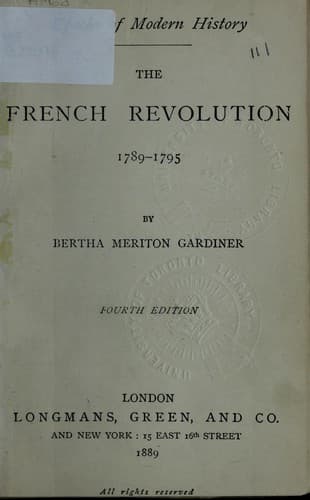
The French Revolution 1789-1795Gardiner, Bertha Meriton
History
The French Revolution 1789-1795
Gardiner, Bertha Meriton
France -- History -- Revolution, 1789-1799
An attempt, headed by the Cordeliers, to get up
an insurrection against the Convention and the two committees failed.
Hébert and eighteen others were arrested and condemned to death by the
revolutionary court on the usual absurd charge of seeking to destroy
the Convention and to restore monarchy (March 24). A few days after
their execution came the turn of the Dantonists. Danton, Desmoulins,
and two other deputies were arrested in the night. The Convention
abandoned them on the demand of St. Just, without a voice speaking
in their defence (March 31). Danton, forewarned, had made no effort
to save himself. Can a man, he replied when urged to fly, take his
country with him on the soles of his shoes? By the court which he had
himself taken part in instituting, he and his friends were condemned as
monarchists and traitors to the Republic. No documents were produced,
and the accused were not suffered to make their defence. ‘On such a
day,’ said Danton in prison, ‘I caused to be erected the revolutionary
court. I ask pardon of God and man.’ Shortly afterwards a new batch
of victims was brought to the scaffold, some Hébertists, others
Dantonists. Amongst them was the widow of Hébert and the young widow
of Desmoulins, with whom, as well as with her husband, Robespierre had
lived on terms of close intimacy.
CHAPTER IX.
THE FALL OF ROBESPIERRE.
♦Dictatorship of the Committee of Public Safety.♦
The members of the Committee of Public Safety now concentrated all the
powers of government in their own hands. The Mountain was crushed
with Danton, the Commune with Hébert. The deputies in mission, who
before had joined the Hébertist party, now sought to guard their heads
by pursuing whatever line of action was indicated to them by the
committee. The Commune was reconstituted and placed under the direction
of two men devoted to Robespierre--its mayor, Fleuriot-Lescot, and
its national agent, Payan. The partisans of Hébert on civil and
revolutionary committees were replaced. The system of popular election
was abandoned even in form, and all reappointments were made either
by the committee itself, or by the Convention at its dictation. The
ministries were abolished, and the ministerial departments divided
between twelve commissions, on which new men were placed.
♦Aims of Robespierre.♦
Public-domain text, read in full here on John Shaqi.
Reviews
Reviews
No reviews yet
Be the first to share your thoughts on this work.
Elsewhere in the archive
Join the Discussion
Join the discussion
Sign in to leave a comment or review.
Sign InorCreate an account