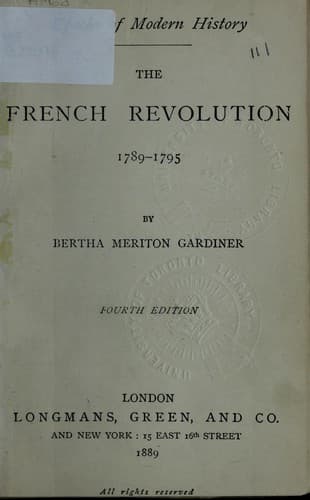
The French Revolution 1789-1795Gardiner, Bertha Meriton
History
The French Revolution 1789-1795
Gardiner, Bertha Meriton
France -- History -- Revolution, 1789-1799
For a moment expectation prevailed that this recognition of a Supreme
Being would be followed by a revival of sentiments of humanity.
The case proved otherwise. The festival was barely over when the
Convention, in accordance with a project drawn up by Robespierre,
reorganised the revolutionary court (June 10). The calling of
witnesses, hearing of counsel, and other forms long since only
partially observed, were formally abolished. The prisoners were brought
before the court in batches of twenty, thirty, or fifty at a time.
A short vaguely-worded charge was read. The president asked each
person his or her name and one or two questions. No evidence on either
side was heard. The jury condemned the accused in a body. To make as
quick as possible the work of judicial massacre, Robespierre’s agents
invented a story that the prisoners were conspiring to save themselves
by assassinating the members of the Convention, and on this charge
persons belonging to every condition of life, brought together from all
quarters of France, were sent pell mell to the scaffold. From the time
of its institution in March 1793 to the passing of this law on June 10,
1794, the court had condemned to death 1,259 persons; after June 18, in
less than seven weeks, it caused the execution of 1,368 persons.
The reorganisation of this court, which Robespierre, by the
reappointment of judges and jurymen, endeavoured to convert into his
special instrument, spread alarm on every side. At this time, indeed,
terror prevailed in official circles to an extent that it would be
difficult to exaggerate. There was no opposition to the Government.
In the Jacobins, the Commune, the Convention, the Sections, no
propositions were made that did not accord with the views of the two
committees. In the Commune, the National agent Payan travestied the
language of Robespierre, as Robespierre in the Convention the language
of Rousseau. In the departments party strife was suppressed as it was
in Paris. The clubs, few of which now numbered more than forty or fifty
members, followed without a will of their own the cue given them from
Paris. All over the country festivals in honour of the Supreme Being
took the place of festivals in honour of Reason. Although Robespierre
proclaimed principles of religious toleration, he neither desired nor
suffered their observance. It is possible that he would never have
ventured, as Hébert had done, to proscribe the Catholic worship, but
the work having been done for him, circumstances would not permit him
to seek supporters by again allowing the celebration of those rites
which still had the affection of the nation. He was at the head of a
Government which could not retrace a step without extreme danger of
weakening its own authority, and it was only by continuing the system
already in force that it was possible for him, as he could not fail
to be aware, to carry his social ideas into practice. Hence the feast
Public-domain text, read in full here on John Shaqi.
Reviews
Reviews
No reviews yet
Be the first to share your thoughts on this work.
Elsewhere in the archive
Join the Discussion
Join the discussion
Sign in to leave a comment or review.
Sign InorCreate an account