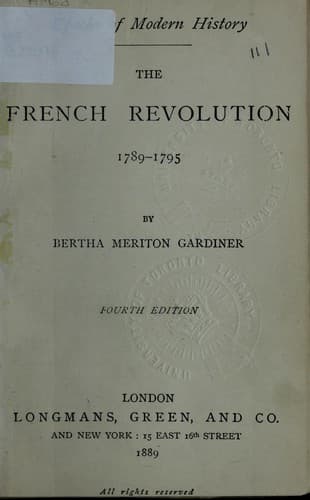
The French Revolution 1789-1795Gardiner, Bertha Meriton
History
The French Revolution 1789-1795
Gardiner, Bertha Meriton
France -- History -- Revolution, 1789-1799
of the Supreme Being, in place of leading to a revival of principles
of humanity, had been followed by a sharpening of the Terror. On the
pretext of maintaining public order, the Catholic worship remained
prohibited. The tyranny weighed down the oppressors along with the
oppressed. Men were imprisoned and sent to the scaffold indifferently
for acts of mercy, knavery, or extravagance. The denouncer of to-day
was the denounced of to-morrow. Municipalities and administrative
bodies trembled before clubs and revolutionary committees; these, in
turn, before deputies in mission; deputies in mission before the two
committees; and the members of the committees before one another.
However high a man’s place in the revolutionary hierarchy, he could not
shelter his best friends or nearest relatives without risking his own
head.
♦Insurrection of Thermidor 10.♦
Violent discords broke out within the Committee of Public Safety.
Robespierre’s efforts to raise himself excited the indignation of his
colleagues; for the more powerful he became, the more insecure was the
tenure on which their own lives rested. On the other hand, Robespierre
was nervous, envious, and suspicious, and the higher he rose the more
eager he became to shed the blood of his enemies, and of those who
stood in the way of his rising higher still. The Montagnards hated him.
Those who had walked behind him at the feast of the Supreme Being had
not been able to restrain themselves from uttering insulting words.
‘Formerly he was master’, one was heard to say, ‘and now he must be God
as well.’ Some, aware that they were objects of his special enmity,
were plotting obscurely against him. Of the twelve members of the
Committee of General Security all but two were his enemies. Supported
by Couthon and St. Just, Robespierre proposed in the Committee of
Public Safety a proscription of several members of the Mountain and of
the Committee of General Security. Billaud and Collot opposed. Consent
would have been suicidal, since they were called on to sacrifice their
own supporters. The cowardly Barère hesitated which side to join. One
member of the Committee of Public Safety had been guillotined with the
Dantonists. The remaining five, though it was not their desire to shed
blood, were accustomed to give their signatures without questioning on
the demand of the governing members, and thus incurred responsibility
for all that took place. They had more in common with Robespierre than
with Collot, since they too cared for order as well as power; but,
while submitting to his ascendancy, they loathed and despised him.
Carnot, who was one of these, and whose success at the head of the war
administration made Robespierre envious, and who could not conceal his
antipathy for Robespierre and St. Just, was marked out for destruction.
The threatened members of the Committee of General Security, afraid
that Billaud and Collot would sacrifice them sooner than come to an
Public-domain text, read in full here on John Shaqi.
Reviews
Reviews
No reviews yet
Be the first to share your thoughts on this work.
Elsewhere in the archive
Join the Discussion
Join the discussion
Sign in to leave a comment or review.
Sign InorCreate an account