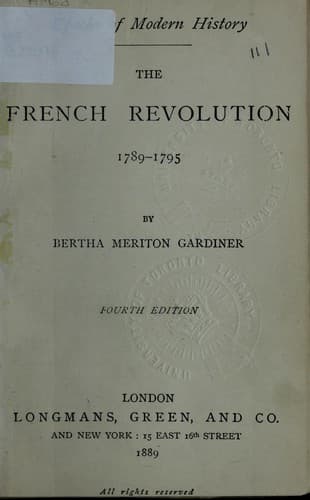
The French Revolution 1789-1795Gardiner, Bertha Meriton
History
The French Revolution 1789-1795
Gardiner, Bertha Meriton
France -- History -- Revolution, 1789-1799
open breach with Robespierre, sought to defend themselves by combining
with the threatened Montagnards. Within the Committee of Public Safety
efforts were made to come to an understanding, but without success.
Robespierre, aware that his enemies were conspiring against him,
determined to strike first, and to secure dictatorship for himself by
replacing his opponents on the two committees by partisans of his own.
There appeared to be little doubt of the result. The Convention had
less reason to support Billaud and Collot than himself. They had been
fully as sanguinary as he; and when Collot in the Convention had once
proposed to send to the scaffold seventy-three deputies of the right
who had been imprisoned for signing protests against the ejection of
the Girondists, he had opposed and saved their lives. In case of a
struggle he had material force at his command, his opponents none.
The Jacobins and the Commune were both his; the national guard, now
called the armed force, was under the command of Henriot, a partisan
of his own. The cannoniers of each section formed a paid force, of
which every man had been selected by the Commune. Robespierre opened
the attack by a long speech in the Convention, in which he complained
of the traitors who spread calumnies against himself (July 26). He
threatened many, but named none. It was a fatal mistake, for each man
in the Convention fancied it possible that his name might be on the
list of proscription. Despair gave courage to the plotters to struggle
for their lives. They belonged to all parties. Some were Hébertists,
others Dantonists, others independent Montagnards. Most were inferior
in character to the man who attacked them. Amongst them were members of
the Committee of General Security, such as the cowardly and ferocious
Vadier and Amar, and the most brutal members of the Convention--Fouché,
who had slaughtered at Lyons, Tallien at Bordeaux, Fréron at
Marseilles, Carrier at Nantes.
When, on the following day, Thermidor 10 (July 27), St. Just ascended
the tribune, he was interrupted almost before he opened his lips.
Shouts were raised of ‘Down, down with the tyrant!’ as Robespierre,
gesticulating and menacing, strove to make himself heard above the
din. The President, a Dantonist, Thuriot, incessantly rang his bell.
The struggle went on for hours. ‘President of assassins’, cried
Robespierre, sinking under exhaustion, ‘for the last time I demand the
right of speech.’ He appealed to the Plain, the members who had been
mere tools in the hands of the strongest party, and who had been mute
against the Mountain since the ejection of the Girondists. But the
Plain, seeing that he was no longer powerful, joined his enemies; and
when it was proposed to arrest himself, his brother, Couthon, and St.
Just, its members rose in a body to confirm the condemnation of the man
before whom they had so long trembled.
Public-domain text, read in full here on John Shaqi.
Reviews
Reviews
No reviews yet
Be the first to share your thoughts on this work.
Elsewhere in the archive
Join the Discussion
Join the discussion
Sign in to leave a comment or review.
Sign InorCreate an account