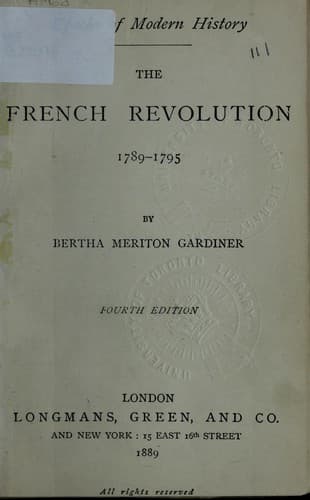
The French Revolution 1789-1795Gardiner, Bertha Meriton
History
The French Revolution 1789-1795
Gardiner, Bertha Meriton
France -- History -- Revolution, 1789-1799
One Director had to retire
yearly, so that the whole body would be renewed in the course of five
years.
♦Vendémiaire 13.♦
This Constitution, put in force as it stood, would have given France
a government formed of new men. But the members of the Convention,
long accustomed to the exercise of power, were unwilling to resign it,
or to hazard the maintenance of the Republic by allowing Royalists
and Monarchists an opportunity of obtaining a majority in the new
Legislature. It was determined to apply at once the principle of
renewing the Legislature by a third of its number every year. A
special law bound the secondary assemblies to elect two-thirds of
their deputies out of the Convention, so that only a single third in
either council would be formed of new men (August 22, Fructidor 5).
There were further to be no new elections till the spring of 1797,
so that for a year and a half the domination of the republican party
was secured. A second law required that if, in consequence of double
elections, all the seats reserved for members of its own body were not
filled, the Convention should elect the deputies required to make up
the number wanting (August 31, Fructidor 13). The new constitution was
submitted to the primary assemblies, and accepted by large majorities,
but with it were coupled these two accessory laws. At Paris popular
indignation was fanned into revolt by the emigrants and royalists. The
Convention depended for its safety on 4,000 troops of the line, and a
few hundred Jacobins and workmen hastily armed for its defence. On the
other side were 20,000 national guards. These, however, were under
two great disadvantages. They had no competent general, and they had
no artillery, all the sections having been deprived of their cannon
after the insurrection of Prairial. The forces of the Convention were
commanded by the deputy Barras, who entrusted the organisation of
resistance to Napoleon Bonaparte, a young general, who was the ablest
man in the service of the Republic, but whose name as yet was hardly
known beyond military circles, where his reputation stood high as the
officer to whose genius was owing the capture of Toulon in 1793. In all
haste a strong force of artillery was brought from a camp at Grenelle,
a few miles from Paris, and stationed round the Tuileries, so as to
command the approaches from the Rue St. Honoré and the Church of St.
Roch, which the insurrectionists occupied. The combat was sharp, but
soon decided. Before nightfall the insurgents were on all sides in
flight and dispersed (October 5, Vendémiaire 13).
Public-domain text, read in full here on John Shaqi.
Reviews
Reviews
No reviews yet
Be the first to share your thoughts on this work.
Elsewhere in the archive
Join the Discussion
Join the discussion
Sign in to leave a comment or review.
Sign InorCreate an account