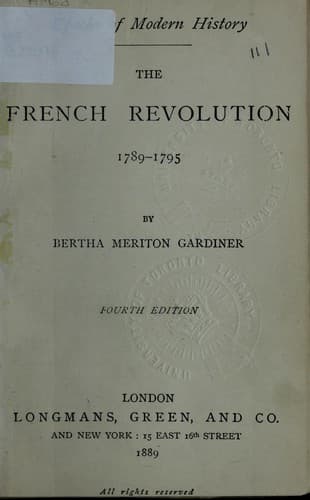
The French Revolution 1789-1795Gardiner, Bertha Meriton
History
The French Revolution 1789-1795
Gardiner, Bertha Meriton
France -- History -- Revolution, 1789-1799
The insurrection, thus quelled, strengthened the Thermidorians and
more violent party in the Convention. New laws were passed, designed
to keep the defeated party down and to insure that power should remain
in the hands of its actual possessors. Deported priests, returned to
France, were ordered to quit the country on pain of suffering, in
accordance with the laws, death as emigrants. Relations of emigrants,
in the first or second degree, such as fathers, brothers, sons, uncles
and nephews, were prohibited from holding any office, judicial,
legislative, or administrative (October 25). This measure, known as the
law of Brumaire 3, was of great political importance. It deprived a
very large number of persons of rights, guaranteed by the Constitution,
and was calculated to prevent the new Government rising above the
character of a purely party Government. Before the arrival of the new
deputies, those of the old members who retained their seats elected to
be Directors five men, all bound by interest to support the Republic,
since all had voted for the death of Louis XVI.
The new Government was therefore formed only in an insensible degree
of new men. The five Directors--Larevellière-Lépeaux, Rewbel, Carnot,
Letourneur, and Barras--the six ministers, and the two councils, stood
in the place of the Committee of Public Safety and the Convention;
but the change was one of name and form, not of system. There was
no change, either in the internal or in the foreign policy of the
Government.
As the Government remained practically unchanged, it could not, by
any possibility, be strong. It had none of that authority which comes
from representing the national will. What that will might be, it was
at the time hard to say. The nation itself had given up the task of
impressing its mind upon its rulers, and contented itself with private
disapprobation of their conduct. In Paris, where that disapprobation
had been expressed in action, it had been promptly silenced by military
intervention, and it was by no means unlikely that the army, which
was now the only strong organisation remaining in the country, might
hereafter intervene against the Directory as it had lately intervened
in its favour.
Public-domain text, read in full here on John Shaqi.
Reviews
Reviews
No reviews yet
Be the first to share your thoughts on this work.
Elsewhere in the archive
Join the Discussion
Join the discussion
Sign in to leave a comment or review.
Sign InorCreate an account