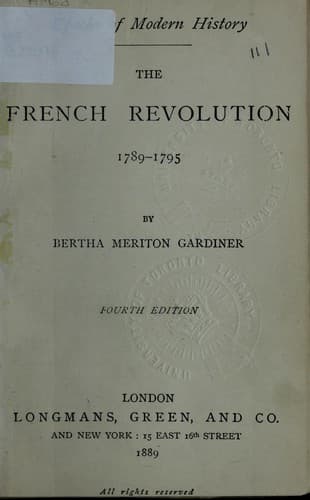
The French Revolution 1789-1795Gardiner, Bertha Meriton
History
The French Revolution 1789-1795
Gardiner, Bertha Meriton
France -- History -- Revolution, 1789-1799
It was the more likely that this would happen because the army did not
owe its strength to its organisation alone. As far as it is possible
to judge, it fairly represented, for the time, the popular sentiment
of the nation. At the outset of the revolution, zeal for improvement
and change had seized upon every variety of mind and upon every class
of the community. The higher minds looked forward to liberty of speech
and thought, and through them to the raising of mankind in the scale of
human progress. The masses looked forward to material equality, to the
removal of the load of outrage and oppression under which they groaned.
For some time it seemed as if these objects could be achieved together.
It was not long before the attempt to grasp too much at a time brought
failure with it. Liberty was trodden down in practice, whilst it
was adored in word. Fraternity became but an excuse for fratricide.
Equality remained as the one aim to be pursued at all hazards, and
the equality which was most in favour was the lower and more material
equality which appealed to the masses of unlettered peasants. For one
man who cared about moral and spiritual advancement there were at least
a hundred who cared only to have a guarantee for their purchases of
confiscated property, and an assurance that they should be under no
disadvantages because they were not of noble birth. Such feelings,
strong in the nation, were strong in the army. The soldier has never
much sympathy for the machinery of a free government. It is his duty
in life to obey orders, not to impose them on his superiors. But the
soldier of revolutionary France was the champion of material equality.
He had offered it to the peoples which he had invaded. It had given to
him that which he prized most, the right of promotion to the superior
ranks of the service, irrespective of birth.
A body which is thoroughly organised, and which represents the
dominant ideas of a people, is, in reality, irresistible. For the
perfect organisation of the army one thing was wanting--a general
who could inspire it with confidence. That general would be found in
the young chief who had fought the battle of the Convention against
the insurgents of Vendémiaire. Because the nation itself was as yet
unprepared to appear upon the scene, the revolutionary epoch was
followed not by the Constitutional but by the Napoleonic age.
Public-domain text, read in full here on John Shaqi.
Reviews
Reviews
No reviews yet
Be the first to share your thoughts on this work.
Elsewhere in the archive
Join the Discussion
Join the discussion
Sign in to leave a comment or review.
Sign InorCreate an account