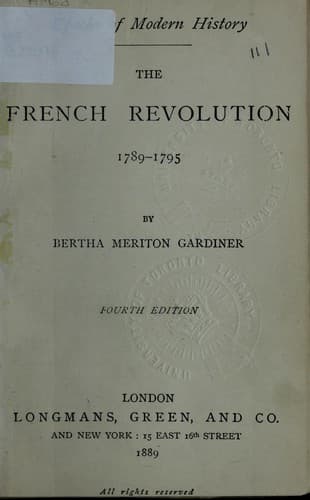
The French Revolution 1789-1795Gardiner, Bertha Meriton
History
The French Revolution 1789-1795
Gardiner, Bertha Meriton
France -- History -- Revolution, 1789-1799
Yet the striving of the political revolutionists had not been in vain.
The time would come when the pursuit of merely material gains would
bring ruin and desolation with it, and the old ideals of the thinkers
of the eighteenth century would again be welcomed by a generation
wearied by military despotism, and which would therefore seek to
establish social and political institutions on a safer basis than
Mirabeau or Vergniaud had been able to do. Nor do even the wild schemes
of Chaumette and St. Just form a mere episode in French history, though
wisely to lighten the load which inevitably falls on the shoulders of
the poor and unfortunate, and thus to diminish the amount of human
suffering, is a work which opens up problems which these men attempted
rashly to cut with the axe of the executioner, but which are now
understood to be amongst the most complicated subjects of political
thought. To trace the fate of the ideas which were thrown up in the
course of the French Revolution would require many volumes. It is
because these ideas were so many sided and so powerful that the French
nation accepts the Revolution, in spite of the errors and crimes of the
revolutionists, as the source of its mental as well as of its political
life.
INDEX.
America, assisted by France, 25;
declaration of Independence by, 26
Army, the French, mutinies in, 73;
disorderly condition of, 105;
extraordinary measures for the enlistment of, 146;
conscription introduced for, 170;
treatment of, by the Hébertists, 188;
reorganisation of, 189
Artois, the Count of, emigrates, 63;
appeals to foreign Powers, 86
Assignats, first issue of, 68;
fresh issues of, 94;
continued issue and depreciation of, 149, 172, 224, 225
Austria, relations of, with Prussia and Turkey, 97, 98;
forms a defensive alliance with Prussia, 104;
war declared by France against, 105;
ill-feeling towards Prussia of, 161;
Thugut, minister of, 162
Avignon, massacre at, 110
Bailly, is chosen mayor of Paris, 47;
addresses the King on his visit to Paris, 48;
execution of, 178
Barbaroux, asks Marseilles to send men to Paris, 116;
execution of, 208
Barère, selfish indifference of, 200;
applauds the financial results of the Terror, 207
Barnave, is a leader of the Centre and Left, 53;
is a rival of Mirabeau, 57;
is popular in the Jacobin Club, 65;
supports the King after the flight to Varennes, 90;
joins the Feuillants, 92;
execution of, 178
Basel, peace of, 238
Bastille, the attack upon, 45;
capture of, 46
Belgium, invaded by the French, 111;
invaded by Dumouriez, 130;
question of the annexation of, 131;
its annexation decreed, 141;
is reconquered by the allies, 161;
is again conquered by the French, 213
Berthier, murder of, 48
Public-domain text, read in full here on John Shaqi.
Reviews
Reviews
No reviews yet
Be the first to share your thoughts on this work.
Elsewhere in the archive
Join the Discussion
Join the discussion
Sign in to leave a comment or review.
Sign InorCreate an account