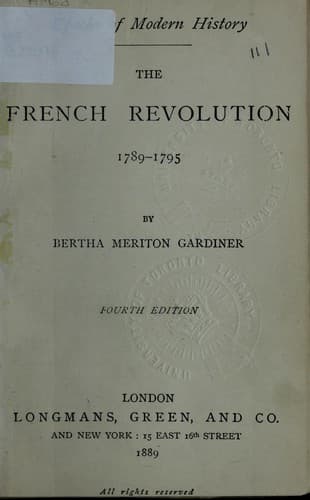
The French Revolution 1789-1795Gardiner, Bertha Meriton
History
The French Revolution 1789-1795
Gardiner, Bertha Meriton
France -- History -- Revolution, 1789-1799
Under the state of things here described, France had retrograded in
wealth and population. Intense misery prevailed amongst the working
classes. Artisans were unable to live on their wages; farmers and
small proprietors were constantly being reduced to beggary; ignorance
grew more dense. The government, by its own frequent setting aside of
laws, and by its intolerance and cruelty, helped to render the people
lawless, superstitious, and ferocious. Protestants were subjected to
persecuting laws. Thousands of them had been driven from the country,
or shot down by troops. The penal code was barbarous, and the brutal
breaking on the wheel was an ordinary mode of putting criminals
to death. It was only by very rough usage that fiscal regulations
were maintained, and the taxes gathered in. If the _taille_ and the
_gabelle_ were not paid, the defaulter’s goods were sold over his
head, and his house dismantled of roof and door. In all cases in
which the administration was concerned, whatever justice peasant and
artisan received was meted to them by administrative officials who
were themselves parties in the cause. Famine was like a disease which
counted its victims by hundreds. As a rule, the farmer was a poor and
ignorant peasant, living from hand to mouth, miserably housed, clothed,
and fed.
An Englishman, Arthur Young, travelling in France in the years
1788–1789, reports how he passed over miles and miles of country once
cultivated, but then covered with ling and broom; and how within a
short distance of large towns no signs of wealth or comfort were
visible. ‘There are no gentle transitions from ease to comfort,
from comfort to wealth; you pass at once from beggary to profusion.
The country deserted, or if a gentleman in it, you find him in some
wretched hole, to save that money which is lavished with profusion in
the luxuries of a capital.’ The same traveller tells us how, as he was
walking up a hill in Champagne, he was joined by a poor woman who
complained of the hardness of the times. ‘She said her husband had
but a morsel of land, one cow and a poor little horse, yet he had a
franchar (42 lbs.) of wheat and three chickens to pay as a quit rent to
one seigneur, and four franchars of oats, one chicken, and one shilling
to pay another, besides very heavy _tailles_ and other taxes. She had
seven children, and the cow’s milk helped to make the soup. It was
said, at present, that something was to be done by some great folks
for such poor ones, but she did not know who nor how, but God send us
better, “car les tailles et les droits nous écrasent.” This woman, at
no great distance, might have been taken for sixty or seventy, her
figure was so bent and her face so furrowed and hardened by labour, but
she said she was only twenty-eight.’
Public-domain text, read in full here on John Shaqi.
Reviews
Reviews
No reviews yet
Be the first to share your thoughts on this work.
Join the Discussion
Join the discussion
Sign in to leave a comment or review.
Sign InorCreate an account