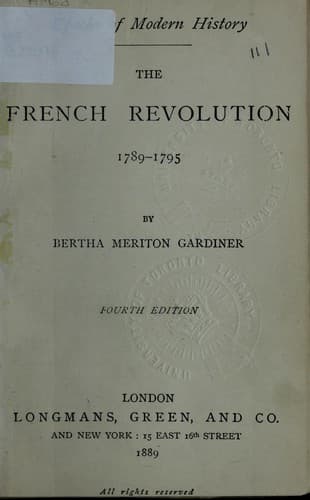
The French Revolution 1789-1795Gardiner, Bertha Meriton
History
The French Revolution 1789-1795
Gardiner, Bertha Meriton
France -- History -- Revolution, 1789-1799
Since, owing to the weight of taxation, no profits were to be made by
farming, it was impossible that there should be a good cultivation of
the soil. The amount of capital employed on land in England was at
least double that employed in France. Hence, while in England famine
was unknown, in France production barely equalled consumption, and
scarcities were of incessant occurrence. A single bad season would
force the farmer to desert his land, and with his family beg or steal.
Whenever bread rose above three halfpence the pound men starved.
Bread riots constantly took place in one or another province, and
the country swarmed with beggars, brigands, poachers, and smugglers.
Thousands of these outcasts were imprisoned, sent to the galleys, or
hanged; but no severity could lessen their number, while the causes
producing them remained unremoved. Adequate means of providing for
the destitute there were none. A few hospitals and other charitable
institutions existed. Bishops, great seigneurs, and monasteries often
kept alive hundreds in seasons of scarcity. Hospitals, however, were
little better than plague houses, where the sick and infirm were taken
in to die, whilst private charity was partial and insufficient. There
was no general system of poor relief. With the object of keeping bread
at a price within the people’s reach, the corn trade was subject to a
variety of regulations and restrictions. Occasionally the government
made purchases of foreign corn, which was resold under price. Sometimes
the prices of corn and other articles of food were fixed. In towns
the price of bread was ordinarily regulated according to the price of
corn by police officers, a not unnecessary precaution when the baking
trade was in the hands of a close corporation. A more vicious mode of
relief could hardly have been devised, but to abandon it was no easy
matter. The arbitrary means taken to reduce the price of corn often had
the effect of raising it, and, when successful, only tended to lessen
production and lead to greater scarcities, since cutting down the
profit of the already overweighted corn grower was, in reality, casting
an additional tax upon him. On the other hand, it was no less true that
so long as the existing order continued, a slight rise in the price of
the pound of bread meant sheer starvation for the mass of artisans, and
for thousands of agricultural labourers and small proprietors who were
not corn growers. Accustomed to look to the government to provide them
with cheap bread, in every season of scarcity these clamoured for a
reduction in price, and unless authorities were complaisant, resorted
to riot and pillage.
♦Voltaire.♦
Public-domain text, read in full here on John Shaqi.
Reviews
Reviews
No reviews yet
Be the first to share your thoughts on this work.
Join the Discussion
Join the discussion
Sign in to leave a comment or review.
Sign InorCreate an account