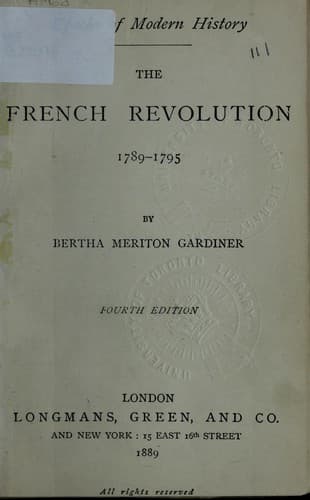
The French Revolution 1789-1795Gardiner, Bertha Meriton
History
The French Revolution 1789-1795
Gardiner, Bertha Meriton
France -- History -- Revolution, 1789-1799
Voltaire himself was a sceptic. Behind him followed men who denied
belief in a personal God and the immortality of the soul. Diderot
(1713–1784) and D’Alembert (1717–1783), with indefatigable energy
published the ‘Encyclopædia,’ or dictionary of universal knowledge,
inculcating, at least indirectly, atheistical opinions, and designed,
by the destruction of ignorance and superstition, to undermine the
whole fabric of Christian theology. Before the end of his long life,
in 1778, Voltaire was the most eminent man in France, and sceptical
and atheistical opinions were commonly held and openly professed by
men and women of the upper and middle classes. The triumph of the new
philosophy was not, indeed, due merely to the powers of irony or the
reasoning of its advocates. The scandalous abuses within the Church
had prepared the way for its reception. The attacked had no efficient
weapon with which to repel their assailants. The Church was without
reforming energy or proselytising zeal. On the arm of the State she
could not rely for support with the same confidence as in former times.
The government was incapable of stamping out the new movement, nor
was it prepared seriously to make the attempt. The official class,
which came out of the middle class, was, like all others, permeated
with the new ideas. The occasional arrest of authors and printers, and
seizure of types and presses, did but increase the virulence of the
attack, and made the forbidden books more eagerly sought after. The
clergy were the more open to attack because they were interested in
the maintenance of privileges and abuses which inflicted cruel wrongs
on the working classes, while the new philosophy aimed at destroying
whatever stood in the way of material progress and the happiness of
the masses. In opposition to the Church’s doctrine of the natural
depravity of human nature, its adherents taught that man is born
good, and that wrong-doing is the result of ignorance; inculcated
the importance of educating all classes, and refused to recognise
limits to the improvement of which both individuals and the race are
capable. Often accompanied by a sensual view of life, which accorded
with the profligacy common amongst the upper classes at the time,
this high opinion of human nature developed a respect for man as man,
regardless of social position, race, or creed, and a passionate hatred
of inequalities founded on such distinctions. ♦Economists.♦ A school of
political economists, starting from the theory that all men originally
had equal rights, and every man liberty to employ his time, his hands,
and his brains according to his own advantage, demonstrated the
principles of free trade, and declared entire liberty of agriculture,
entire liberty of commerce and industry, entire liberty of the press to
be the true foundations of national prosperity. Appealing to abstract
principles of justice, humanity and right, Voltairians and Economists
Public-domain text, read in full here on John Shaqi.
Reviews
Reviews
No reviews yet
Be the first to share your thoughts on this work.
Join the Discussion
Join the discussion
Sign in to leave a comment or review.
Sign InorCreate an account