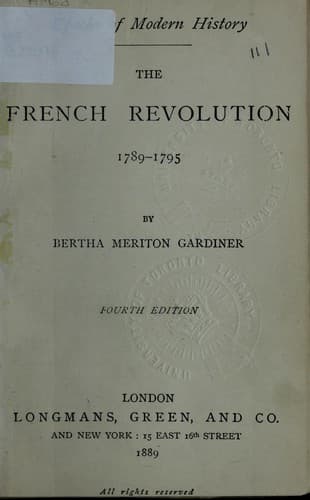
The French Revolution 1789-1795Gardiner, Bertha Meriton
History
The French Revolution 1789-1795
Gardiner, Bertha Meriton
France -- History -- Revolution, 1789-1799
The misery of the working classes presented in itself reason enough for
revolution; but revolution only comes when there are men of ideas to
lead the unlettered masses. In France the educated classes entertained
revolutionary ideas, and the men of letters who promulgated those ideas
became the leaders of opinion, and exerted enormous influence over
their own and the following generations. First came the Voltairians,
led by Voltaire (1694–1778). During the century rapid advance was
being made in all branches of study--in history, jurisprudence,
mathematical and physical science. The idea of progress was definitely
conceived, and knowledge upheld as the chief factor in producing
virtue and happiness. For the increase and diffusion of knowledge the
recognition of two principles was indispensable--religious toleration
and the freedom of the press. Both these principles were, however,
in direct antagonism to the principles on which the authority of the
Roman Catholic Church was based--unity of faith and worship, the
subordination of philosophy and science to theology, the submission
of reason to the teaching of tradition. Protestant clergymen were put
to death as late as 1762; while in 1765 a lad convicted of sacrilege
was hanged, and his body afterwards burned. Such acts of intolerance
and cruelty were, however, condemned by public opinion, and, between
the Church and the exponents of the new ideas, violent collision
inevitably ensued. Voltaire made it the work of his life to destroy
belief in revealed religion. In verse and in prose, in historical
works, in letters and pamphlets by the dozen, with rude licence or sham
respect, he held up the Church to derision, indignation, and contempt,
as the great enemy of enlightenment and humanity. ‘The most absurd of
empires,’ he wrote, ‘the most humiliating for human nature, is that of
priests; and of all sacerdotal empires, the most criminal is that of
priests of the Christian religion.’
♦Encyclopædists.♦
Public-domain text, read in full here on John Shaqi.
Reviews
Reviews
No reviews yet
Be the first to share your thoughts on this work.
Join the Discussion
Join the discussion
Sign in to leave a comment or review.
Sign InorCreate an account