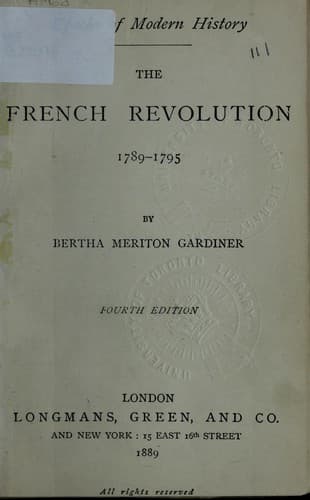
The French Revolution 1789-1795Gardiner, Bertha Meriton
History
The French Revolution 1789-1795
Gardiner, Bertha Meriton
France -- History -- Revolution, 1789-1799
When the necessity of reform had been demonstrated by a band of
powerful and brilliant writers, whose works were the popular reading of
the day, it was inevitable that desire for change should grow, as the
new ideas spread over wider circles, and sufferers from abuses became
more and more alive to their wrongs. Undermined by public opinion,
the existing order could not endure for long, and the vital question
before France was, by what means change should be accomplished. The
Voltairians called on the King to take the work in hand, and on the
death of Louis XV. in 1774, it appeared possible that the young Louis
XVI. would endeavour to regain the path that his predecessors had
abandoned, and, by relieving the people from their burdens, seek the
welfare of the entire nation. ♦Turgot’s Ministry.♦ Turgot, the new
Controller-General, who exercised the functions both of Minister of
Finance and Minister of the Interior, represented the party of reform,
and was in all his actions inspired by a strong love of knowledge and
by a passionate desire to benefit his fellow-men. He was not, like
the writers of his time, a mere theorist, but also a practised and
successful administrator, who for thirteen years had been Intendant of
the poor province of Limousin. Now that he was invested with higher
authority, it was Turgot’s aim to ameliorate the condition of the
people throughout France, by the introduction of reforms based on
those principles of equality and individual liberty which Voltairians
and Economists proclaimed. His chief reforms were the abolition of
restrictions on the internal trade in corn and wine; the abolition of
the _corvée_, or forced unpaid labour of the peasants for repair of
roads, for which he substituted a land-tax payable by all proprietors
whether privileged or not; and finally, the abolition of guilds, giving
liberty to every one, however poor, to exercise what trade he pleased
and to raise his condition according to his capacity. Besides these,
his most important measures, Turgot carried out many lesser reforms
tending to set labour and industry free, to cheapen food and clothing,
and to lessen the burdens of the poor by the equalisation of taxation,
and by the abolition of the fiscal abuses and sinecure offices which
enriched the monied aristocracy of Paris and the court nobility. The
reforms, however, which Turgot accomplished were but a small portion
of those which he had in contemplation. He aimed at the remodelling
of the whole system of taxation, the removal of all custom-houses to
the frontier, the abolition of the _gabelle_, and the substitution for
the _taille_ of a new tax to be imposed on the land of all proprietors
without exception, the gradual abolition of feudal dues, the grant
of civil rights to Protestants, and, finally, the decentralisation
of administration by the establishment of provincial assemblies, to
be elected by all landed proprietors without distinction of rank.
Public-domain text, read in full here on John Shaqi.
Reviews
Reviews
No reviews yet
Be the first to share your thoughts on this work.
Join the Discussion
Join the discussion
Sign in to leave a comment or review.
Sign InorCreate an account