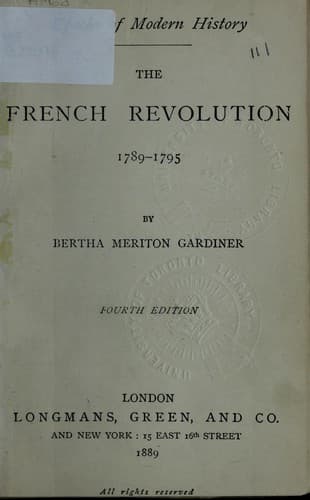
The French Revolution 1789-1795Gardiner, Bertha Meriton
History
The French Revolution 1789-1795
Gardiner, Bertha Meriton
France -- History -- Revolution, 1789-1799
His work was no sooner begun than it was prematurely cut short. A
violent opposition party was at once formed, which comprised the court
nobility, the upper clergy, the nobility of office, farmers of the
_gabelle_ and other indirect taxes, judges in Parliament, masters of
guilds and state officials--in a word, all those who made profit out of
existing abuses, and whose special privileges were assailed. ‘Everybody
fears,’ a friend of Turgot wrote to him, ‘either for himself, or for
his brother, or for his friend.’
♦Louis XVI.♦
Whether Turgot was to stand or fall depended entirely on the resolution
of the King. Louis XVI. was well-intentioned, conscientious, and
sincerely desirous of ruling for the good of his subjects, but he
lacked the qualities which are requisite to a prince called on to
govern at a great national crisis. He was without self-confidence,
irresolute in action, and incapable of judging the real value of men,
or of grasping the real bearing of events and measures. He could not
even rule his own court. Simple in his tastes, and shy and reserved by
disposition, his happiest hours were spent in the hunting field, or
in the company of a blacksmith, mastering the art of making locks. It
was no wonder that such a King should be driven to and fro between
conflicting opinions, when those who surrounded his throne, and with
whom he came in daily contact, accused his Minister of violence and
injustice, and of entertaining projects destructive to monarchical
government. ‘The King,’ said Turgot, ‘is above all, for the good of
all.’ Louis could never rise to this conception of his position.
Turgot would have made him ruler of men equal before the law, and in
possession of equal rights as citizens. Desirous as Louis was to ease
the lower classes of their burdens, he was never able to conceive
of the noble as being on the same footing as the common man. ♦Marie
Antoinette.♦ The only person in whom he reposed confidence was his
wife, Marie Antoinette, a daughter of the Empress Maria Theresa, and
with fatal weakness he often yielded to her desires in opposition
to his own better judgment. She had been married to him while still
a child, and left to grow up uninstructed and without guides in the
corrupt atmosphere of the court of Versailles. At the age of nineteen,
when she became Queen, she was a bright and vivacious, but ignorant
and thoughtless woman, whose days were spent in a never ceasing round
of formalities and dissipation. She employed her influence over her
husband to obtain for her friends pensions and offices, without any
sense of what was due to her position as Queen in the midst of a
frivolous and intriguing court, or of what she owed to the starving
and suffering masses who were deprived of their hard-won earnings for
the enrichment of an idle and spendthrift nobility. When ministers
sought to put a check on her extravagance, or in any way thwarted her
inclinations, they provoked her resentment, dangerous in proportion to
Public-domain text, read in full here on John Shaqi.
Reviews
Reviews
No reviews yet
Be the first to share your thoughts on this work.
Join the Discussion
Join the discussion
Sign in to leave a comment or review.
Sign InorCreate an account