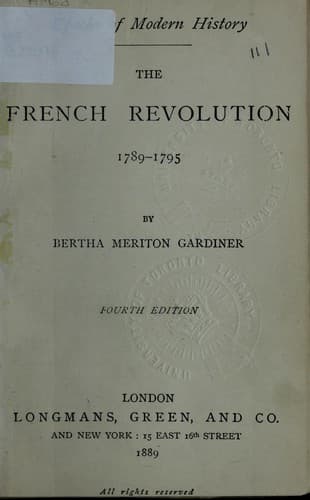
The French Revolution 1789-1795Gardiner, Bertha Meriton
History
The French Revolution 1789-1795
Gardiner, Bertha Meriton
France -- History -- Revolution, 1789-1799
the power that she was able to exercise over the King. Her aversion
to Turgot was the cause which finally produced his dismissal from
office. The Austrian ambassador, Mercy, informing Maria Theresa of the
event, used words of more pregnant meaning than he was himself aware.
‘The Controller-General,’ he said, ‘is of high repute for integrity,
and is loved by the people; and it is therefore a misfortune that his
dismissal should be in part the Queen’s work. Such use of her influence
may one day bring upon her the just reproaches both of her husband and
of the entire nation.’
Turgot was the greatest statesman that France had seen since Richelieu.
He had a clear comprehension of the economical and social evils under
which the country suffered, and of the remedies to be applied to them.
The best ideas of the age found room in his capacious mind, and all
that he attempted to do had ultimately to be accomplished, though by
other means than those which he contemplated. Louis had shown his
incapacity to see that it was his first duty to make himself the
repairer of wrong and injustice, and truly a representative king, who
could say, ‘I am the nation.’ After Turgot’s failure, revolution,
that is to say change accompanied by violence and convulsion, became
inevitable.
♦Reforming movement a European one.♦
The reforming movement, of which in France Turgot was the
representative, was not confined to that country, but was, in fact, an
European movement, of which the influence was felt, however faintly,
even in the most backward States. Kings and statesmen, under the
influence of Voltairian ideas, held sceptical opinions, and took
interest in the material condition of their subjects. It was perceived
that if monopolies enriched individuals they prevented the development
of commerce and industry; that if duties were levied between the
provinces of the same kingdom, exchange of commodities could only
with difficulty be effected; that if nobles did not pay their fair
share of taxation, the revenue of the State suffered, and the working
classes were overburdened. Jealous eyes were cast upon the territorial
wealth of the Catholic Church, and protests were raised against the
multiplication of monasteries, and the idle lives led by their inmates.
In many States efforts were made to increase the authority of the king
by the destruction of provincial and class privileges. The idea that
the sovereign reigned for the good of the nation was accepted, at
least in theory, by the most autocratic of European princes. In Russia
Catherine II., in Prussia Frederick II., invited to their courts and
patronised French philosophers. In Spain Aranda, in Tuscany Manfredini,
in Portugal Pombal endeavoured to lessen the privileges of nobles
and clergy, and to loosen the bonds in which industry and commerce
were held. In Savoy feudal charges were abolished, compensation being
given to the proprietors. In Parma, in Brunswick, and in other Italian
Public-domain text, read in full here on John Shaqi.
Reviews
Reviews
No reviews yet
Be the first to share your thoughts on this work.
Join the Discussion
Join the discussion
Sign in to leave a comment or review.
Sign InorCreate an account