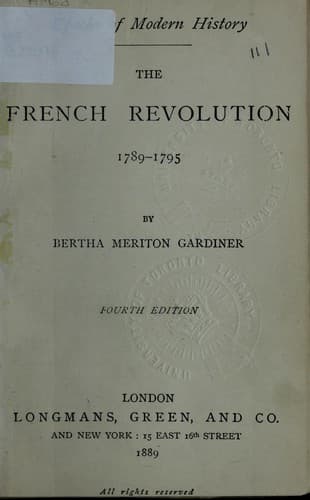
The French Revolution 1789-1795Gardiner, Bertha Meriton
History
The French Revolution 1789-1795
Gardiner, Bertha Meriton
France -- History -- Revolution, 1789-1799
In writing this handbook on the French Revolution, it has been my
endeavour to give a correct and impartial account of the most important
events of the revolutionary period, and of the motives by which the
leading characters were actuated. Much has necessarily been omitted
which finds a place in larger works. Those who wish to pursue the
subject further, and have time at their disposal, would do well to
study, besides general histories, some of the many books lately
published which deal with special branches of the subject, and often
enable the reader to form a more independent judgment both of men and
events than is possible from the perusal of works of the former class
alone. Amongst general histories those of Michelet and Louis Blanc
will probably be found most serviceable. No satisfactory account of
the relations of France with other countries is to be found in the
French tongue, partly because French historians still write with bias,
partly, also, because they hitherto either have been unacquainted
with, or have ignored the results of German research. Professor Von
Sybel’s well-known book, ‘Geschichte der Revolutionszeit,’ contains
the fullest and best account of the relations which existed between
the different States of Europe, but it is not an impartial one.
Hermann Hüffer’s books are valuable contributions to our knowledge of
diplomatic relations, and, being written from an opposite point of
view, should be studied by all readers of Von Sybel. The history of the
foreign policy of England during this period has still to be written.
M. Sorel has lately published in the pages of the ‘Révue Historique’ a
full account of the foreign policy pursued by the Committee of Public
Safety after Robespierre’s fall, and of the negotiations leading
to the treaties of peace signed in 1795 between France and Prussia
and France and Spain. Much fresh information regarding the internal
condition of France during the revolutionary period is to be found
scattered in local and special histories of various kinds. Amongst
such may be specially mentioned Mortimer Ternaux’s ‘Histoire de la
Terreur,’ and ‘La Justice Révolutionnaire,’ by Berriat St. Prix. M.
Taine in his great work has collected a large number of extracts from
documents lying in the archives of the departments, but entire absence
of classification, and the strong political bias of the writer, makes
this work of less value to the student than others of less pretensions.
Amongst the best of local histories are the works of M. Francisque
Mège, which reveal the course taken by the Revolution in the province
of Auvergne. Biographical works are numerous. Mirabeau’s character
will best be learnt from his correspondence with the Count de la
Marck. M. D’Héricault’s ‘Révolution de Thermidor’ contains a detailed
account of the policy pursued by Robespierre after the expulsion of
the Girondists. Danton’s life and character can best be studied in
the works of M. Robinet. Schmidt’s ‘Pariser Zustände während der
Public-domain text, read in full here on John Shaqi.
Reviews
Reviews
No reviews yet
Be the first to share your thoughts on this work.
Join the Discussion
Join the discussion
Sign in to leave a comment or review.
Sign InorCreate an account