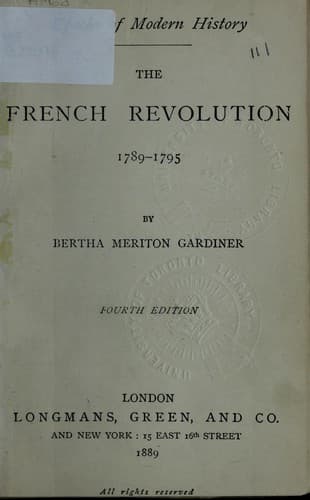
The French Revolution 1789-1795Gardiner, Bertha Meriton
History
The French Revolution 1789-1795
Gardiner, Bertha Meriton
France -- History -- Revolution, 1789-1799
In England the same ideas prevailed as on the Continent, but the social
and political condition of the country was such as to enable reforms
to be accomplished more gradually and with far less violent change
than was possible either in France or Austria. The English people had
for centuries formed an united nation. No sharp lines of division
divided one class from another. The laws were the same for all: younger
sons of noblemen ranked as commoners, and country gentlemen sat in
Parliament by the side of merchants and traders. A free press prepared
the way for change by allowing the discussion of questions of general
interest, and free institutions gave political experience, and taught
the governing classes the necessity of yielding in time to public
opinion. Parliament, which represented only the landed and commercial
interests, legislated selfishly, and was slow to admit or redress wrong
done to the unrepresented classes; but gross oppression of the lower
orders, such as existed in France, was unknown in England. Country
gentlemen looked after the affairs of parish and county. The body of
the rural population consisted of agricultural labourers maintained
by poor-rates when wages fell short. Charges on land due to the lord
of the manor, though far from being extinct, existed mainly in the
form of money payments, affecting only a comparatively small number of
persons. Although the same protective principles which prevailed on
the Continent prevailed also in England, whatever restraints were laid
either on persons in the selection of their calling, or on industry,
commerce and agriculture, there was to be found far more liberty than
elsewhere. The country was the most flourishing in Europe, and wealth
was being rapidly accumulated. Special advance was made in the system
of farming by the introduction of the rotation of crops and artificial
manures. Wages rose, and bread was cheap, and all classes for a time
shared in the general prosperity.
In England a large body of eminent men, philosophers, statesmen, and
philanthropists, entertained the new ideas and sought to bring them
into practice. In 1776, Adam Smith published the ‘Wealth of Nations,’
in which the principles of free trade were promulgated. The younger
Pitt, who took office in 1783, was his disciple. He proposed to abolish
restrictions on the trade of Ireland with England, and intended to
lessen the power of the aristocracy by a reform of the electoral
system. In 1787 a Treaty of Commerce was concluded between England and
France, designed to increase trade between the two countries. The most
important measures brought forward by Pitt were not, however, carried
through Parliament. This was in part owing to the factious opposition
of the Whigs, in part to the strong Conservative instincts of the
governing classes, but in part also because little discontent or desire
for change existed among the people at large.
♦Ministry of Necker.♦
Public-domain text, read in full here on John Shaqi.
Reviews
Reviews
No reviews yet
Be the first to share your thoughts on this work.
Join the Discussion
Join the discussion
Sign in to leave a comment or review.
Sign InorCreate an account