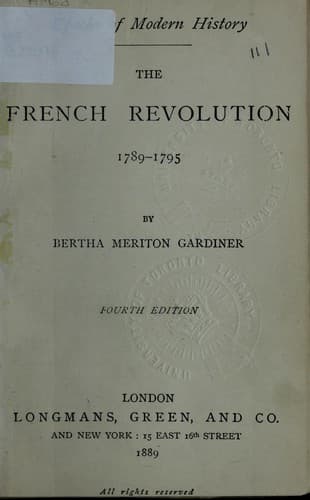
The French Revolution 1789-1795Gardiner, Bertha Meriton
History
The French Revolution 1789-1795
Gardiner, Bertha Meriton
France -- History -- Revolution, 1789-1799
If, however, England was slow to move, reforms once made rested on a
sure foundation. Such was not the case with those made in the name of
absolute princes on the Continent. After Turgot’s dismissal, fifty
out of seventy of the guilds which he had abolished were revived,
and the peasants were compelled by blows to resume their labours
on the roads. Necker, a Genevese banker, was Turgot’s successor
(October 1776). He was not a statesman, like Turgot, with definite
aims in view, but he was an able financier and a humane man, holding
the philanthropic sentiments of the day, and eager to relieve the
condition of the masses. A war with England increased the difficulties
of the government. In 1778 Louis, reluctantly following public
opinion, assisted the English colonies in America in their struggle
for independence. There were only three means of meeting the expenses
of the war: increased taxation, economy, and loans. The first was
impossible; the second only possible to a limited extent; and Necker,
therefore, was compelled to borrow. The loans that he opened were
quickly filled up, because men of the middle class, who were the chief
lenders, believed that their interests were safe while he directed the
finances. But the public debt was greatly increased, and the prospect
of the future, with reforms uneffected in the system of taxation,
rendered them more dark. Although Necker did not attempt to introduce
radical measures such as had excited opposition against Turgot, his
abolition of sinecures and other administrative changes gave offence
to the same classes. The Parliament of Paris, whose lead was followed
by the twelve provincial Parliaments, formed the chief organ of
resistance. These Parliaments or law-courts were, in fact, powerful
legal corporations to which many hundred persons were attached. The
judges belonged to the nobility of office, and were independent of the
government, since they held their offices in right of purchase, and
might not be dispossessed without proof of misconduct. They exercised,
besides judicial, a certain political function, since edicts of the
King’s council did not have the force of law until they had been
registered by the Parliaments. This right of registration in the
time of Louis XIV. had been a mere form. If the Parliament of Paris
hesitated to carry out his wishes, he held a so-called bed of justice
when he came to the court in person, and on his command registration
was compulsory. But now that the royal authority had fallen into
contempt, the Parliaments offered prolonged resistance, and before
the Government could obtain registration of its edicts, intimidation
and even the use of military force were resorted to. Necker, when he
sought to effect reform, necessarily became involved in quarrels with
the Parliaments, and, finding that the King gave but a half-hearted
support, he resigned office (1781).
♦Desire for political liberty.♦
Public-domain text, read in full here on John Shaqi.
Reviews
Reviews
No reviews yet
Be the first to share your thoughts on this work.
Join the Discussion
Join the discussion
Sign in to leave a comment or review.
Sign InorCreate an account