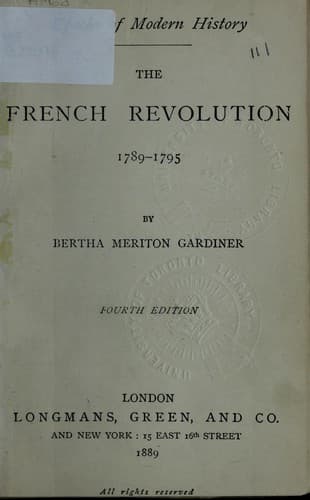
The French Revolution 1789-1795Gardiner, Bertha Meriton
History
The French Revolution 1789-1795
Gardiner, Bertha Meriton
France -- History -- Revolution, 1789-1799
The question round which for the time discussion centred was the form
to be taken by the States-General, as its solution would decide whether
political supremacy should rest with the first two orders or with the
Third Estate. Nobles and clergy demanded, in the first place, that they
should each be represented by as many deputies as the Third Estate; in
the second, that the deputies of each order should sit by themselves
in a separate chamber, and that each chamber should vote apart. The
bourgeoisie, backed by the people, on their side denied the right of
the two first orders to a separate representation, and demanded that
in any case the deputies of the Third Estate should equal in number
the deputies of nobles and clergy combined, and that the three orders
should sit together, forming a single chamber. The dispute engendered
strong displays of party feeling, leading to riot and bloodshed. The
Parliaments, formerly popular for contesting the royal authority, were
now hooted and mobbed for supporting the demands of nobles and clergy.
If at the present juncture Louis had taken clearly and unreservedly the
side of the nation, it might have been possible for the crown to gain
immense popularity and influence. The bourgeoisie, however democratic
its theories of government, was warmly attached to the monarchy, and
thoroughly loyal to the person of the King. But Louis, who had rejected
Turgot, was again incapable of making himself the leader of the nation.
In summoning the States he had acted, not through policy, but under
stress of circumstances which he was unable to control. He expected the
deputies of the Third Estate to aid him in subjecting the nobles to
taxation, and in carrying out administrative reforms; but he could not
understand that they expected him to join with them in destroying every
vestige of the old feudal system, and in establishing a completely
democratic rule. In relation to the point immediately at issue, the
King went so far as it seemed to suit his own purpose, and no further.
Accepting Necker’s advice, he consented that the deputies of the Third
Estate should equal in number the deputies of both clergy and nobles.
Whether after meeting the deputies were to sit as three chambers or as
one was left undecided.
CHAPTER III.
THE ASSEMBLY AT VERSAILLES.
♦The King and the Revolution.♦
Public-domain text, read in full here on John Shaqi.
Reviews
Reviews
No reviews yet
Be the first to share your thoughts on this work.
Join the Discussion
Join the discussion
Sign in to leave a comment or review.
Sign InorCreate an account