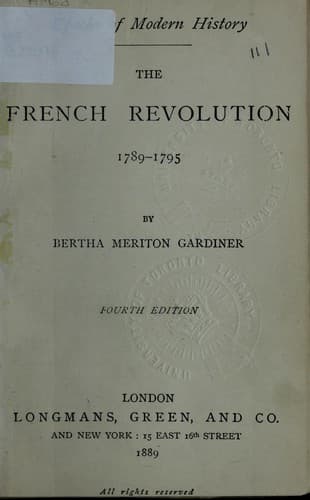
The French Revolution 1789-1795Gardiner, Bertha Meriton
History
The French Revolution 1789-1795
Gardiner, Bertha Meriton
France -- History -- Revolution, 1789-1799
Siéyès’ nation was a nation of twenty-five millions. The first two
orders numbered together about 1,500,000 persons. That they were
a minority was in itself no ground for crushing them. Reason and
justice might as well lie on the side of the minority as on that of
the majority. But Siéyès’ arguments were in existing circumstances
perfectly sound and unanswerable. The nobles represented no national
interests, and had long ceased to be the organs through which the
nation expressed its wants. To the exercise of political powers they
had no claim whatever. Their privileges and prejudices had for years
stood in the way of the common good. They were without experience
in political life, and as a rule without experience even in matters
of government and administration. Their position amongst their
fellow-citizens was that of an isolated caste; in short, all the bonds
of connection were wanting which cause men to place reliance in others,
and to accept them as leaders.
The privileges of the clergy and their claims to exercise power as
a special order met with as little favour as those of the nobles.
Clergy and laity were to stand on exactly the same footing with regard
to civil and political rights. The combined influence of sceptical
and liberal ideas made men desire to withdraw from the Church all
coercive means of maintaining authority. The press was to be free,
worship was also to be free, and nonconformists were to enjoy full
civil and political rights. Equality was to prevail within the Church
as well as within the State. The government of the Church was to be
reorganised on a democratic basis, and the Pope’s authority, as head
of the Church, to be confined to matters purely spiritual. Although
the provincial nobles were jealous of the great lords, and desired to
deprive them of whatever advantages they possessed above themselves,
yet the nobility as a body still formed a caste, of which all members,
except a small minority, were united in asserting rights and claiming
privileges in opposition to the rest of the nation. The clergy, on the
contrary, though held together by common interests as ecclesiastics,
were torn asunder by the same class divisions that prevailed amongst
laymen. The upper clergy, who were all of noble birth, proposed to
maintain authority in their own hands and to effect ecclesiastical
reform from inside; while the curés, who came from the ranks of the
people, demanded State interference, as the only means of securing for
themselves a full representation in Church councils, and a just share
in the distribution of Church property.
♦Double representation of the Third Estate.♦
Public-domain text, read in full here on John Shaqi.
Reviews
Reviews
No reviews yet
Be the first to share your thoughts on this work.
Join the Discussion
Join the discussion
Sign in to leave a comment or review.
Sign InorCreate an account