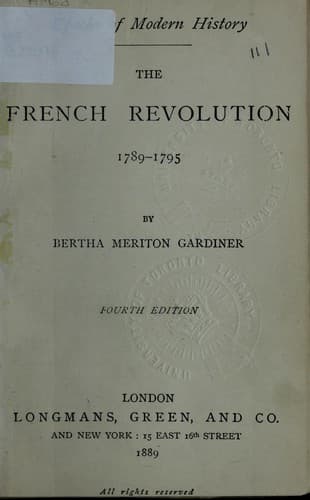
The French Revolution 1789-1795Gardiner, Bertha Meriton
History
The French Revolution 1789-1795
Gardiner, Bertha Meriton
France -- History -- Revolution, 1789-1799
In the National Assembly which represented France as it was in 1789,
the party did not, as has been seen, number more than from twenty to
thirty, but its weakness in the Assembly was fully atoned for by its
strength in the Jacobins. This society had developed into a political
organ which was none the less powerful because its authority was
not recognised by the laws. During 1790 and 1791 Jacobin clubs were
established in most provincial towns, and even in mere villages. They
were generally affiliated to the head or mother society at Paris, with
which they maintained a regular correspondence. Thus, at a time when
all other bonds of cohesion had been destroyed or had fallen away,
there was rising into existence over France, outside the constitution,
a network of authorities, directed from a common centre in Paris.
The clubs, in fact, perpetually interfered with the administrative
bodies, tendering advice which often assumed the form of dictation
or intimidation, and were always able, if they pleased, to get up
demonstrations in favour of their own views. They represented that
spirit of distrust which was everywhere felt and seemed to pervade the
very air men breathed; and if more moderate politicians disapproved
the violent language often used in them, and their assumptions of
administrative authority, they did not desire their suppression, for
the reason that their fear of danger from this source was less than
their fear of the triumph of reactionists and the undoing of the work
of the revolution.
In September 1790, the ministry had been dissolved in consequence of
attacks made on it by the Jacobins of Paris. Necker, painfully alive
to his loss of popularity, left the country unregretted (September),
and his colleagues, alarmed at the charges brought against them,
shortly afterwards resigned. Louis after this put men in office known
to be opposed to the restoration of the old order, but they possessed
as little influence on the Assembly as their predecessors. The right
refused them support, because they did not belong to the party of
reaction; and the left, because their attachment to the existing
constitution was called in question.
♦Commune of Paris.♦
Public-domain text, read in full here on John Shaqi.
Reviews
Reviews
No reviews yet
Be the first to share your thoughts on this work.
Elsewhere in the archive
Join the Discussion
Join the discussion
Sign in to leave a comment or review.
Sign InorCreate an account