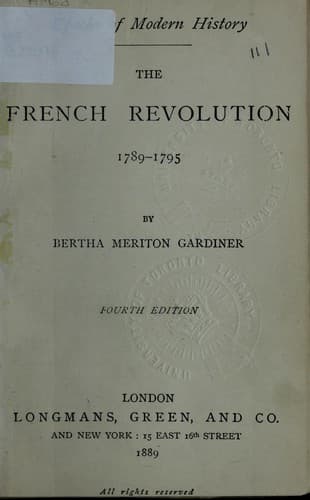
The French Revolution 1789-1795Gardiner, Bertha Meriton
History
The French Revolution 1789-1795
Gardiner, Bertha Meriton
France -- History -- Revolution, 1789-1799
Besides the Jacobin Club, other machinery existed at Paris by aid of
which the ultra-democrats were gradually paving the way for their
own advent to power. In September 1790, the commune of Paris was
reorganised in accordance with a special law, being divided into 48
sections, each of which had its primary assembly, composed of active
citizens. Out of a population of 800,000, 84,000 were entitled to vote.
Each of the 48 primary assemblies, commonly known as the sections, had
a permanent committee, whose business it was to execute the orders
of the municipality, and to carry out police regulations within the
section. The municipality itself, of which Bailly was re-elected mayor,
consisted of a general council of 96 and an executive of 44 members.
It did its best to maintain order and support the constitution. Its
position, however, was a difficult one. Work was scarce, crime rife,
the prisons crowded. Liberty of speech and of the press was on all
sides abused. There were no laws by which political agitation, though
it took the form of treason to the constitution, could be legally
suppressed. In the sections, owing to the withdrawal into private
life of men of moderate views, the ultra-democrats were often able to
obtain the upper hand. The permanent committees, in place of obeying
the municipality, sometimes disputed authority with it or took an
independent course of their own. All the 48 primary assemblies were
entitled to meet whenever eight of their number made the demand in
legal form. In the poorer sections agitators, by unceasing hostile
criticism, undermined amongst the lower classes the popularity of
the Assembly, of the municipality, of Lafayette, and of the national
guard. Amongst many popular clubs, founded in different parts of Paris,
the _Cordeliers_ south of the Seine acquired special notoriety. Here
presided Danton, an orator distinguished among his fellows by the zeal
and energy which he flung into the contest with the municipality.
♦Mirabeau’s policy and death.♦
Public-domain text, read in full here on John Shaqi.
Reviews
Reviews
No reviews yet
Be the first to share your thoughts on this work.
Elsewhere in the archive
Join the Discussion
Join the discussion
Sign in to leave a comment or review.
Sign InorCreate an account