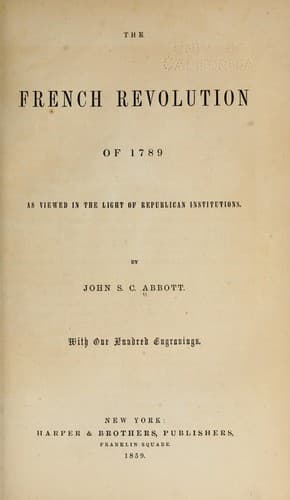
The French Revolution of 1789, as Viewed in the Light of Republican InstitutionsAbbott, John S. C. (John Stevens Cabot)
History
The French Revolution of 1789, as Viewed in the Light of Republican Institutions
Abbott, John S. C. (John Stevens Cabot)
France -- History -- Revolution, 1789-1799
"But it was in the evening (of July 14th) that the spectacle exhibited
by the Assembly was truly sublime. I shall not attempt to describe
the various emotions of joy, grief, and terror which at different
moments agitated those who were merely spectators and strangers in the
Assembly. But the expression is improper; we were none of us strangers.
For myself, I felt as a Frenchman, because I felt as a man. Nothing
could be more distracting than our uncertainty concerning the state
of Paris, from whence no person was suffered to stir. The Viscount de
Noailles[160] after repeated interruptions had contrived at last to get
away; but the intelligence which he brought served only to quicken our
impatience and increase our alarms.
"He knew that a multitude of people in search of arms had forced their
way into the Hospital for Military Invalids; that the Bastille was
besieged; that there had been already much bloodshed; that the troops
encamped in the Field of Mars were expected every moment to march
to the relief of that fortress, which could not be effected without
deluging all Paris in blood.
"At this dreadful news the Assembly was penetrated with horror.
A number of the members started from their seats by a kind of
involuntary impulse, as if determined to hasten to the defense of their
fellow-citizens. Others were for immediately bursting into the king's
presence to remonstrate with him on what had happened; to say to him
'Behold the fruits of your counsels; hear the cries of your victims;
see the destruction which is about to overwhelm your capital; say, are
you the king or the murderer of your people?'
"But these tumultuous emotions gave place to the more temperate measure
of sending a numerous deputation to the king, to represent to him the
calamities which threatened Paris, and again to conjure him to remove
the army. A long time elapsed, and the deputation did not return.
No one could account for the delay. In the mean time there came a
message that two deputies from the body of electors at Paris desired
admittance. They were instantly ordered in. Not a breath was heard;
every ear was attentive: every eye was strained; every mind was upon
the rack. From some unaccountable mistake it was some time before they
entered. Never was impatience wrought up to a higher pitch. At last
they appeared at the bar."[161]
Public-domain text, read in full here on John Shaqi.
Reviews
Reviews
No reviews yet
Be the first to share your thoughts on this work.
Elsewhere in the archive
Join the Discussion
Join the discussion
Sign in to leave a comment or review.
Sign InorCreate an account