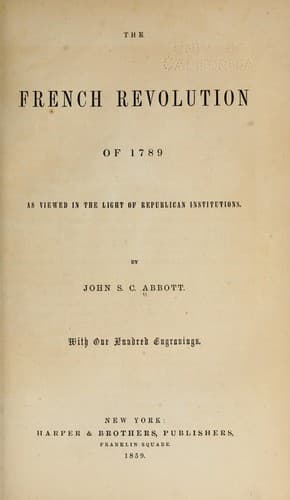
The French Revolution of 1789, as Viewed in the Light of Republican InstitutionsAbbott, John S. C. (John Stevens Cabot)
History
The French Revolution of 1789, as Viewed in the Light of Republican Institutions
Abbott, John S. C. (John Stevens Cabot)
France -- History -- Revolution, 1789-1799
But let us leave the Assembly listening at midnight of the 14th to
the narrative of the deputies from Paris, while we enter the city
to witness the transactions there. At three o'clock Monday morning
tumultuous masses of men were filling the streets. The barriers,
at which a tax had been levied upon all articles of food and other
merchandise which entered the city, had been seized, set on fire, and
were now blazing. It was expected every moment that the troops would
enter to sweep the streets with grapeshot; and from every steeple the
tocsin was pealing, summoning the people to arms. Thousands of those
who thronged the city, houseless wanderers, were haggard and wan with
famine, and knew not where to get a mouthful of bread.
There was a rumor that in the convents of the Lazarites a vast amount
of wheat was hoarded up. Resistless, like an inundation, the hungry
multitude poured in at the doors and filled the convent from attic to
cellar. They found vast quantities of wine in the vaults and more than
fifty cart-loads of wheat. They drank the wine freely, fed themselves,
and sent the wheat to the market to be distributed. But they would
allow no _stealing_. One wretch who was detected as a thief was
immediately hung by the populace![162]
They then ransacked the city in pursuit of arms. Every sword, musket,
and pistol from private residences was brought forward. The shops of
the gunsmiths furnished a small supply. The royal arsenal, containing
mainly curiosities and suits of ancient armor, was ransacked, and,
while all the costly objects of interest were left untouched, every
available weapon was taken away. The prison of La Force was filled
with debtors. The populace broke down the doors and liberated these
unfortunate men, incarcerated for no crime. The prison of the Chatelet
was filled with convicts. These felons, hearing of the tumult and of
the release of the prisoners of La Force, rose upon their keepers and
endeavored to batter down their doors. The same populace, called upon
by the keepers of the Chatelet, entered the court-yard of the prison,
and, with pike and bayonet, drove the convicts back again to their
cells.
[Illustration: SACKING THE ROYAL ARSENAL.]
Crowds were assembled around the Hôtel de Ville, where the electors
had met, demanding arms and the immediate establishment of a citizen's
guard. But the electors moved with great caution. They did not feel
authorized to establish the guard without the approval of the Assembly;
and the Assembly had not ventured to adopt the measure without the
consent of the king.
Public-domain text, read in full here on John Shaqi.
Reviews
Reviews
No reviews yet
Be the first to share your thoughts on this work.
Elsewhere in the archive
Join the Discussion
Join the discussion
Sign in to leave a comment or review.
Sign InorCreate an account