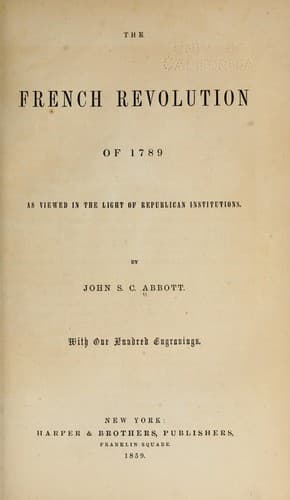
The French Revolution of 1789, as Viewed in the Light of Republican InstitutionsAbbott, John S. C. (John Stevens Cabot)
History
The French Revolution of 1789, as Viewed in the Light of Republican Institutions
Abbott, John S. C. (John Stevens Cabot)
France -- History -- Revolution, 1789-1799
At the death of Charles Martel, his son Pepin, a man of great energy
and ambition, drove the imbecile king, Childeric III., into a cloister,
and took his seat unresisted upon the throne. The dynasty thus
established is called the Carlovingian, from Charlemagne, the most
illustrious of this line of kings. The nation cordially approved of
the act. As Pepin could not claim the throne by right of hereditary
descent, he founded his title to reign upon the regal power which his
father had in _reality_ exercised, and upon the well-known assent of
the nation. To confirm his authority still more, he appealed to the
Pope. The Church was now in the plenitude of its power; and the Pope,
grateful for the service which Charles Martel had rendered the Church
by driving back the infidels, with alacrity consented to establish
Pepin upon the throne by the august rites of religion.
Pepin, as his leading warriors had now become horsemen, changed the
time of the general assemblies from the month of March to May, as
the latter month was more convenient for forage, and the Assembly
hence received the name of Fields of May, _Champs de Mai_. At these
meetings the king presided, and the body was composed of the higher
clergy and the nobility. Occasionally, a small delegation of the most
distinguished of the people, who were called the Third Estate, _Tiers
Etat_, had been admitted. Pepin called together only the clergy and
the nobility, declining to admit the Third Estate to the Assembly.
Subsequently some kings admitted the Third Estate, and others excluded
them, according to their caprice. Questions relating to war, peace, and
the enactment of general laws were submitted to this body, and decided
by the majority. The chiefs only could speak. The assembled warriors
clamorously and with clashing of arms expressed assent or dissent.
The world-renowned Charlemagne, succeeding his father Pepin, ascended
the throne in the year 768. France at that time presented every where
an aspect of decay and wild disorder. This monarch, illustrious both
as a warrior and a statesman, fused the heterogeneous and warring
tribes into a compact nation. Still, the mass, though consolidated, was
conglomerate, its component parts distinctly defined. All France bowed
submissive to his sway. Like a whirlwind he traversed Spain with his
armies. Italy speedily acknowledged his supremacy. The vast empire of
Charlemagne soon vied with that of ancient Rome, embracing nearly the
whole of Europe.
Public-domain text, read in full here on John Shaqi.
Reviews
Reviews
No reviews yet
Be the first to share your thoughts on this work.
Join the Discussion
Join the discussion
Sign in to leave a comment or review.
Sign InorCreate an account