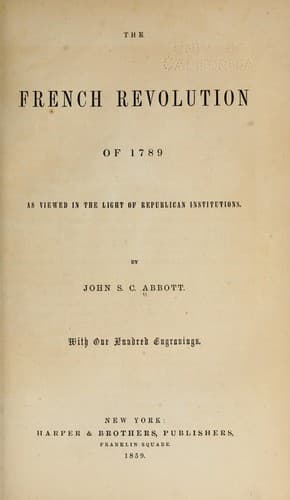
The French Revolution of 1789, as Viewed in the Light of Republican InstitutionsAbbott, John S. C. (John Stevens Cabot)
History
The French Revolution of 1789, as Viewed in the Light of Republican Institutions
Abbott, John S. C. (John Stevens Cabot)
France -- History -- Revolution, 1789-1799
It was an important point in the policy of Charlemagne to humble the
nobles. He wished to surround his throne with an aristocracy enjoying
privilege and splendor, but deprived of all political power. He wished
himself to appoint the rulers of the provinces, and not to allow those
offices to be hereditary with the counts and the dukes. Therefore he
endeavored to ally the _people_ with himself in resisting the powerful
barons. He also, with the same object in view, sedulously courted the
affections of the Church, conferring many of the most important offices
of the state upon the high ecclesiastics.
Charlemagne ordered the Assembly to meet twice every year. Every
count was commanded to bring to this congress thirteen of the most
influential of the people within his jurisdiction. They usually met in
two bodies, the ecclesiastical leaders in one spot, the military in
another. Sometimes, by order of the king, they both met together. The
king held his court at a little distance, and by messengers received
constant reports from the two bodies. Weighing the result of their
deliberations, he issued his decree, which all recognized as law. Such
was the germ of deliberative assemblies in France.
Charlemagne established several schools. In these he assembled for
severe study many of the young men of the empire, selecting the
low-born as well as the sons of the nobles. As he was very desirous
that his reign should be embellished by the attainments of men of
letters, he frequently examined these schools himself. One of the
historians of those days writes:
"When, after a long absence, Charlemagne returned to Gaul, he ordered
the children to be brought to him, to show him their exercises and
verses. Those belonging to the lower classes exhibited works beyond all
hope, but those of noble descent had only trifles to show. The wise
monarch, imitating the Eternal Judge, placed those who had done well on
his right hand, and thus addressed them:
"'A thousand thanks, my sons, for your diligence in laboring according
to my orders and for your own good. Proceed. Endeavor to perfect
yourselves, and I will reward you with magnificent bishoprics and
abbeys, and you shall be ever honorable in my sight.'
"Then he bent an angry countenance upon those on his left hand, and,
troubling their consciences with a lightning look, with bitter irony,
and thundering rather than speaking, he burst upon them with this
terrible apostrophe:
"'But for you, nobles, you sons of the great--delicate and pretty
minions as you are, proud of your birth and your riches--you have
neglected my orders and your own glory, and the study of letters, and
have given yourselves up to ease, sports, and idleness.'
"After this preamble, raising on high his august head and his
invincible arm, he fulminated his usual oath:
Public-domain text, read in full here on John Shaqi.
Reviews
Reviews
No reviews yet
Be the first to share your thoughts on this work.
Join the Discussion
Join the discussion
Sign in to leave a comment or review.
Sign InorCreate an account