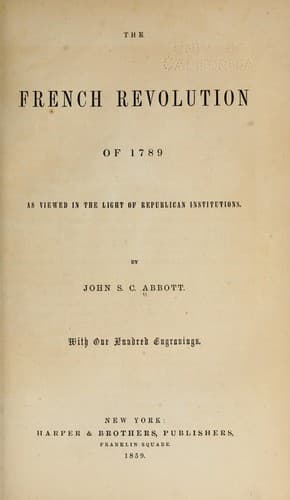
The French Revolution of 1789, as Viewed in the Light of Republican InstitutionsAbbott, John S. C. (John Stevens Cabot)
History
The French Revolution of 1789, as Viewed in the Light of Republican Institutions
Abbott, John S. C. (John Stevens Cabot)
France -- History -- Revolution, 1789-1799
It was this peril which armed France. Villages, peasants, all were
united to defend themselves against these terrible brigands. The
arsenals of the old castles contained arms. Nerved by despair, the
roused multitudes simultaneously besieged all these castles, and
demanded and seized the weapons necessary for their defense. It was as
a movement of magic. A sudden danger, every where menacing, every where
worked the same result. In one short week France sprung up armed and
ready for war. Three millions of men had come from the furrow and the
shop, and fiercely demanded "Where are the brigands? Lead us to meet
our foes, whoever and wherever they may be."[201]
The lords in an hour found themselves helpless. The peasants, hitherto
so tame and servile, were now soldiers, roused to determination and
proud of their newly discovered power. Awful was the retribution. The
chateaux blazed--funeral fires of feudality--on every hill and in
every valley. One can only be surprised that the hour of retribution
should have been delayed for so many ages, and that when it came the
infuriated, degraded, brutalized masses did not proceed to even greater
atrocities. Though deeds of cruelty were perpetrated which cause the
ear that hears to tingle, still, on the whole, mercy predominated.
In many cases lords who had treated their serfs kindly were protected
by their vassals, as children would protect a father. The Marquis of
Montfermail was thus shielded from harm. In Dauphiné a castle was
assailed during the absence of the lord. His lady was at home alone
with the children. The peasants left the castle and its inmates
unharmed, destroying only those feudal charters which were the
title-deeds of despotism.
These titles, engrossed on fine parchment and embellished with gorgeous
seals, were the pride of the noble family--the evidence of their
antiquity. They were preserved with great reverence, deposited in
costly caskets, which caskets, enveloped in velvet, were safely placed
in oaken chests, and those chests, iron-ribbed and with ponderous
locks, were guarded in a strong part of the feudal tower. The peasants
ever gazed with awe upon the tower of the archives. They understood the
significancy of those title-deeds--the badges of their degradation,
the authority to which the lords appealed in support of their tyranny,
insolence, and nameless outrages.
Public-domain text, read in full here on John Shaqi.
Reviews
Reviews
No reviews yet
Be the first to share your thoughts on this work.
Elsewhere in the archive
Join the Discussion
Join the discussion
Sign in to leave a comment or review.
Sign InorCreate an account