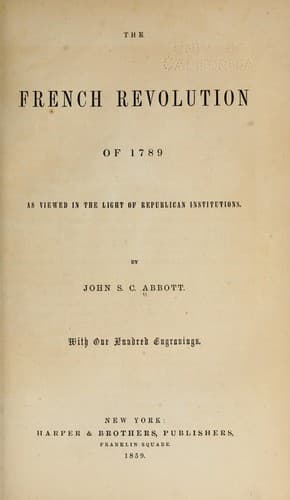
The French Revolution of 1789, as Viewed in the Light of Republican InstitutionsAbbott, John S. C. (John Stevens Cabot)
History
The French Revolution of 1789, as Viewed in the Light of Republican Institutions
Abbott, John S. C. (John Stevens Cabot)
France -- History -- Revolution, 1789-1799
"Our country-people," writes Michelet, "went straight to the tower.
For many centuries that tower had seemed to sneer at the valley,
sterilizing, blighting, oppressing it with its deadly shadow. A
guardian of the country in barbarous times, standing there as a
sentinel, it became later an object of horror. In 1789 what was it but
the odious witness of bondage, a perpetual outrage to repeat every
morning to the man trudging to his labor the everlasting humiliation
of his race? 'Work, work on, son of serfs! Earn for another's profit.
Work, and without hope.' Every morning and every evening, for a
thousand years, perhaps more, that tower had been cursed. A day came
when it was to fall.
"O glorious day, how long have you been in coming! How long our fathers
expected and dreamed of you in vain! The hope that their sons would
at length behold you was alone able to support them, otherwise they
would have no longer consented to live. They would have died in their
agony. And what has enabled me, their companion, laboring beside them
in the furrow of history and drinking their bitter cup, to revive the
suffering Middle Ages, and yet not die of grief? Was it not you, O
glorious day, first day of liberty? I have lived in order to relate
your history!"
Thus far the religious sentiment of France, as expressed by nearly all
the pastors and the great proportion of their Christian flocks, was
warmly in favor of the Revolution. The higher clergy alone, bishops,
archbishops, and cardinals, who were usually the younger sons of the
nobles, and were thus interested in the perpetuation of abuses, united
with the lords. As in the National Assembly so it was in the nation
itself, that the working clergy were among the most conspicuous of
the sons of freedom. Religious services were held in the churches in
grateful commemoration of the fall of the Bastille.[202] The vast
cathedral of Nôtre Dame was thronged to listen to a sermon from the
Abbé Fauchet, who consecrated to the memory of those who fell on that
occasion the homage of his extraordinary eloquence. He selected for his
text the words of St. Paul, "For, brethren, ye have been called unto
liberty."--Gal. v. 13.
"The false interpreters of the divine oracle," said the abbé, "have
wished, in the name of heaven, to keep the people in subjection to
the will of their masters. They have consecrated despotism. They
have rendered God an accomplice with tyrants. These false teachers
exult because it is written, '_Render unto Cæsar the things that are
Cæsar's_.' But that which is not Cæsar's, is it necessary to render to
him that? And _liberty_ does not belong to Cæsar. It belongs to human
nature."[203]
Public-domain text, read in full here on John Shaqi.
Reviews
Reviews
No reviews yet
Be the first to share your thoughts on this work.
Elsewhere in the archive
Join the Discussion
Join the discussion
Sign in to leave a comment or review.
Sign InorCreate an account