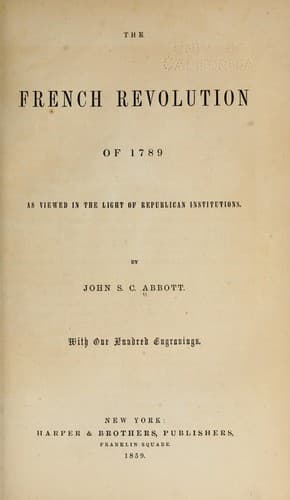
The French Revolution of 1789, as Viewed in the Light of Republican InstitutionsAbbott, John S. C. (John Stevens Cabot)
History
The French Revolution of 1789, as Viewed in the Light of Republican Institutions
Abbott, John S. C. (John Stevens Cabot)
France -- History -- Revolution, 1789-1799
The abbé unquestionably read the divine oracles aright. The
corner-stone of true democracy can only be found in the word of God.
The revelation there presented of God as a common father, and all
mankind as his children, made of one blood, brethren--it is that
revelation upon which is founded the great fundamental principle of
democracy, equality of rights. The very highest attainment of political
wisdom is the realization of the divine word, _"Whatsoever ye would
that others should do unto you, do ye even so unto them_."
The whole audience were transported with the clear and eloquent
enunciation of the politics of the gospel of Christ. As the orator
left the sacred cathedral he was greeted with the loudest plaudits. A
civic crown was placed upon his brow, and two companies of the National
Guard escorted him home, with the waving of banners and the clangor of
trumpets, and through the acclamations of the multitudes who thronged
the streets.[204]
While France was in this state of tumult and terror, threatened with
invasion from abroad, and harassed by brigands at home, the nobles
plotting treason, law powerless, and universal anarchy reigning, the
National Assembly was anxiously deliberating to restore order to the
country and to usher in the reign of justice and prosperity. The old
edifice was destroyed. A new one was to be erected. But there were now
three conspicuous parties developing themselves in the Assembly.
The first was composed of the nobles and the higher clergy, who still,
as a body, adhered to the court, and who eagerly fomented disorders
throughout the kingdom, hoping thus to compel the nation, as the only
escape from anarchy, to return to the old monarchy.
The second was composed of the large proportion of the Assembly,
sincere, intelligent, patriotic men, earnest for liberty, but for
liberty restrained by law. They were almost to a man monarchists,
wishing to ingraft _upon the monarchy of France_ institutions similar
to those of republican America. The English Constitution was in the
main their model.
A third party was just beginning to develop itself, small in numbers,
of turbulent, visionary, energetic men, eager for the overthrow of
all the institutions and customs of the past, and for the sudden
introduction of an entirely new era. Making no allowance for the
ignorance of the masses, and for the entire inexperience of the French
in self-government, they wished to cut loose from all the restraints of
liberty and of law, and to plunge into the wildest freedom.
Public-domain text, read in full here on John Shaqi.
Reviews
Reviews
No reviews yet
Be the first to share your thoughts on this work.
Elsewhere in the archive
Join the Discussion
Join the discussion
Sign in to leave a comment or review.
Sign InorCreate an account