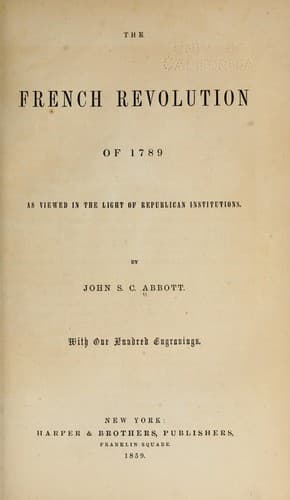
The French Revolution of 1789, as Viewed in the Light of Republican Institutions — John Shaqi
The French Revolution of 1789, as Viewed in the Light of Republican InstitutionsAbbott, John S. C. (John Stevens Cabot)
History
The French Revolution of 1789, as Viewed in the Light of Republican Institutions
Abbott, John S. C. (John Stevens Cabot)
France -- History -- Revolution, 1789-1799
The writer would not take up his pen merely to repeat the story
which has so often and so graphically been told before. But it is
expecting too much of human nature to imagine that the struggles of an
oppressed people to emancipate themselves from feudal despotism can
be impartially narrated in the castles of nobles or in the courts of
kings. It is inevitable that the judgment which is pronounced upon the
events which such a struggle involves will be biased by the political
principles of the observer. Precisely the same transaction will by one
be condemned and by another applauded. He who believes in the divine
right of kings to reign and in the divine obligation of the people
unquestioning to obey, must condemn a people who endeavor to break
the shackles of despotic power, and must applaud kings and nobles
who, with all the energies of bomb-shells, sabres, and iron hoofs,
endeavor to crush the spirit of democratic freedom. On the contrary, he
who accepts the doctrine that sovereignty resides in the people must
commend the efforts of an inthralled nation to sever the chains of
servitude, and must condemn the efforts of kings and nobles to rivet
those chains anew. Thus precisely the same facts will be regarded with
a very different judgment according as the historian is influenced by
political principles in favor of equality of rights or of aristocratic
privilege. The author of this work views the scenes of the French
Revolution from a republican stand-point. His sympathies are strongly
with an oppressed people struggling for political and religious
liberty. All writers, all men profess to love liberty.
"Despots," says De Tocqueville, "acknowledge that liberty is an
excellent thing. But they want it all for themselves, and maintain that
the rest of the world is unworthy of it. Thus there is no difference of
opinion in reference to liberty. We differ only in our appreciation of
men."[1]
To commence the history of the French Revolution with the opening of
the States-General in 1789 is as unphilosophical as to commence the
history of the American Revolution with the battle of Lexington. No man
can comprehend this fearful drama who does not contemplate it in the
light of those ages of oppression which ushered it in. It is in the
horrible despotism of the old monarchy of France that one is to see the
efficient cause of the subsequent frantic struggles of the people.
"The Revolution," says De Tocqueville, "will ever remain in darkness to
those who do not look beyond it. Without a clear view of society in the
olden time, of its laws, its faults, its prejudices, its sufferings,
its greatness, it is impossible to understand the conduct of the French
during the sixty years which have followed its fall."[2]
Public-domain text, read in full here on John Shaqi.
Reviews
Reviews
No reviews yet
Be the first to share your thoughts on this work.
Join the Discussion
Join the discussion
Sign in to leave a comment or review.
Sign InorCreate an account