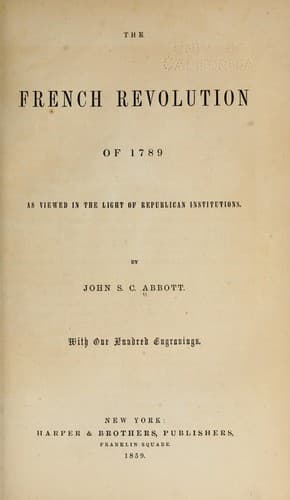
The French Revolution of 1789, as Viewed in the Light of Republican InstitutionsAbbott, John S. C. (John Stevens Cabot)
History
The French Revolution of 1789, as Viewed in the Light of Republican Institutions
Abbott, John S. C. (John Stevens Cabot)
France -- History -- Revolution, 1789-1799
There is often an impression that the Revolution was a sudden outbreak
of blind unthinking passion--a tempest bursting from a serene sky; or
like a battle in the night--masses rushing blindly in all directions,
and friends and foes in confusion and phrensy smiting each other. But,
on the contrary, the Revolution was of slow growth, a storm which had
been for centuries accumulating. The gathering of the clouds, the
gleam of its embosomed fires, and the roar of its approaching thunders
arrested the attention of the observing long before the storm in all
its fury burst upon France. A careful historic narrative evolves order
from the apparent chaos, and exhibits, running through the tumultuous
scene of terror and of blood, the operation of causes almost as
resistless as the operation of physical laws.
The writer has freely expressed his judgment of the transactions which
he has narrated. "The impartiality of history," says Lamartine, "is
not that of a mirror which merely reflects objects; it should be that
of a judge who sees, listens, and decides."[3] The reader will not be
surprised to find that some occurrences which historians caressed in
regal courts and baronial halls have denounced as insolent and vulgar
are here represented as heroic and noble.
Every generous heart will respond to the sentiment uttered, in this
connection, by Thiers. "I have endeavored to stifle," he says, "within
my own bosom every feeling of animosity. I alternately figured to
myself that, born in a cottage, animated with a just ambition, I was
resolved to acquire what the pride of the higher classes had unjustly
refused me; or that, bred in palaces, the heir to ancient privileges,
it was painful to me to renounce a possession which I regarded as
a legitimate property. Thenceforth I could no longer harbor enmity
against either party. I pitied the combatants, and I indemnified myself
by admiring generous deeds wherever I found them."[4]
One simple moral this whole awful tragedy teaches. It is, that the laws
must be so just as to command the assent of every enlightened Christian
mind, and the masses of the people must be trained to such intelligence
and virtue as to be able to appreciate good laws and to have the
disposition to maintain them. Here lies the only hope of our republic.
The illustrations which embellish these pages are from the artistic
pencil of Mr. C.E. Doepler, who went to Paris that he might with more
historical accuracy delineate both costumes and localities. To the
kindness of Messrs. Goupil & Co. we are indebted for the privilege
of copying the exquisite engraving of Marie Antoinette at the
Revolutionary tribunal, which forms the Frontispiece.
John S. C. Abbott.
Brunswick, Maine, Nov., 1858.
FOOTNOTES:
[Footnote 1: The Old Régime and the Revolution, by Alexis de
Tocqueville, Introduction, p. xi.]
[Footnote 2: Ib., p. 253.]
[Footnote 3: Lamartine, History of the Girondists, i., 10]
[Footnote 4: Thiers, French Revolution, Introduction.]
Public-domain text, read in full here on John Shaqi.
Reviews
Reviews
No reviews yet
Be the first to share your thoughts on this work.
Join the Discussion
Join the discussion
Sign in to leave a comment or review.
Sign InorCreate an account