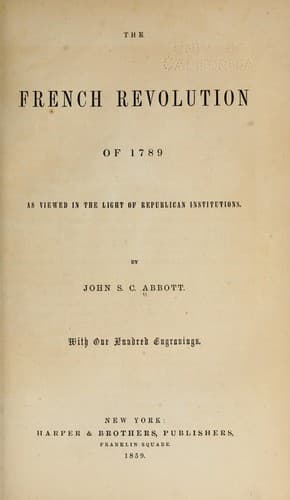
The French Revolution of 1789, as Viewed in the Light of Republican InstitutionsAbbott, John S. C. (John Stevens Cabot)
History
The French Revolution of 1789, as Viewed in the Light of Republican Institutions
Abbott, John S. C. (John Stevens Cabot)
France -- History -- Revolution, 1789-1799
The House of Valois.--Luxury of the Court and the
Nobles.--Insurrection.--Jaques Bonhomme.--Henry III.--Henry
IV., of Navarre.--Cardinal Richelieu.--French Academy.--Regency
of Anne of Austria.--Palaces of France.--The Noble and the
Ennobled.--Persecution of the Protestants.--Edict of Nantes.--Its
Revocation.--Distress of the Protestants.--Death of Louis XIV.
In the year 1328 the direct line of the Capets became extinct by
the death of Charles IV., who left no male descendant. The nobles,
assembled in parliament at Paris, assigned the crown to Philip, Count
of Valois, a nephew of the former king. He was crowned at Rheims,
in May, 1328, as Philip VI. The nobles, having thus obtained a king
according to their wishes, complained to him that they had borrowed
large sums of money from wealthy merchants and artisans, which it was
inconvenient for them to pay, and that it was not consistent with the
dignity of the French nobility that they should be harassed by debts
due to the low-born. The king promptly issued a decree that all these
debts should be cut down one fourth, that four months grace should be
allowed without interest, and then, that these plebeian creditors might
be reduced to a proper state of humility, he ordered them all to be
imprisoned and their property to be confiscated. The merciless monarch
doubled the taxes upon the people, and created a court at Paris of
such magnificence that the baronial lords abandoned their castles and
crowded to the metropolis to share its voluptuous indulgences. Even
neighboring kings, attracted by the splendor of the Parisian court,
took up their abode in Paris. The nobles needed vast sums of money to
sustain them in such measureless extravagance. They accordingly left
stern overseers over their estates, to drive the peasants to their toil
and to extort from them every possible farthing.
The king, to replenish his ever-exhausted purse, assumed the sole right
of making and selling salt throughout the realm. Each family, always
excepting the nobles, who were then exempted from every species of tax,
was required to take a certain quantity at an exorbitant price.
Vincennes was then the great banqueting-hall of Europe. In its present
decay it exhibits but little of the grandeur it presented four hundred
years ago, when its battlements towered above the forest of oaks,
centuries old, which surrounded the castle--when plumed and blazoned
squadrons met in jousts and tournaments, and when, in meteoric
splendor, hunting bands of lords and ladies swept the park. Brilliant
as was this spectacle, no healthy mind can contemplate it but with
indignation. To support this luxury of a few thousand nobles, thirty
millions of people were plunged into the extreme of ignorance, poverty,
and misery.
Public-domain text, read in full here on John Shaqi.
Reviews
Reviews
No reviews yet
Be the first to share your thoughts on this work.
Join the Discussion
Join the discussion
Sign in to leave a comment or review.
Sign InorCreate an account