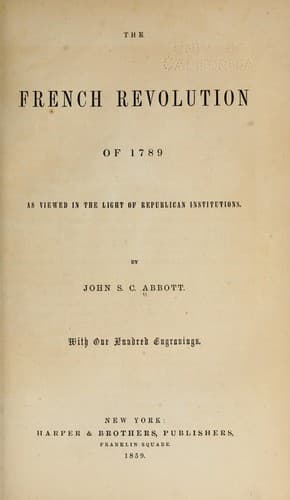
The French Revolution of 1789, as Viewed in the Light of Republican Institutions — John Shaqi
The French Revolution of 1789, as Viewed in the Light of Republican InstitutionsAbbott, John S. C. (John Stevens Cabot)
History
The French Revolution of 1789, as Viewed in the Light of Republican Institutions
Abbott, John S. C. (John Stevens Cabot)
France -- History -- Revolution, 1789-1799
For two hundred and fifty years under the Capets, France could hardly
be called a kingdom. Though the name of king remained, the kingly
authority was extinct. The history of France during this period is
but a history of the independent feudal lords, each of whom held his
court in his own castle. None of these kings had power to combine
the heterogeneous and discordant elements. The fragile unity of the
realm was broken by differences of race, of customs, of language, and
of laws. But in this apparent chaos there was one bond of union, the
Church, which exerted an almost miraculous sway over these uncultivated
and warlike men. The ecclesiastics were strongly in favor of the
Capets, and were highly instrumental in placing them upon the throne.
With the Capets commenced a royal line which, in its different
branches, running through the houses of Valois and of Bourbon, retained
the throne for eight hundred years, until the fall of Louis XVI. in
1793.
About the year 1100 we begin to hear the first faint murmurs of the
people. Some bold minds ventured the suggestion that a man ought to
be free to dispose of the produce of his own labor, to marry his
children without the consent of another, to go and come, sell and buy
without restriction. Indeed, in Normandy the peasants broke out in a
revolt. But steel-clad knights, in sweeping squadrons, cut them down
mercilessly and trampled them beneath iron hoofs. The most illustrious
of the complainants were seized and hung to the trees, as a warning
to all murmurers. The people were thus taught that trees made good
gibbets. When their turn came they availed themselves of this knowledge.
In the year 1294 Philip the Fair established a court in Paris called
the Parliament. This was purely an aristocratic body, and was, in
general, entirely subservient to the king's wishes. Similar parliaments
were established by the great feudal princes in their provinces. There
were occasional contentions between the parliaments and the king,
but the king usually succeeded in compelling them to obedience. The
Parliament enjoyed only the privilege of registering the royal edicts.
In the reign of Louis XIV. the Parliament ventured to express a little
objection to one of the tyrannical ordinances of the monarch.
The boy-king, eighteen years of age, was astounded at such impudence.
He left the chase, and, hastening to the hall, entered it whip in
hand. He could send them one and all to the Bastille or the block, and
they knew it, and he knew it. The presence of the king brought them to
terms, and they immediately became as submissive as fawning spaniels.
FOOTNOTES:
[Footnote 5: Greg. Tur., book ii., c. 28.]
[Footnote 6: Monach. Sangall, b. i., c. ii., sqq., as quoted by
Michelet.]
[Footnote 7: See the abundant proof of these statements in Michelet's
History of France, p. 193.]
CHAPTER II.
THE HOUSES OF VALOIS AND BOURBON.
Public-domain text, read in full here on John Shaqi.
Reviews
Reviews
No reviews yet
Be the first to share your thoughts on this work.
Join the Discussion
Join the discussion
Sign in to leave a comment or review.
Sign InorCreate an account