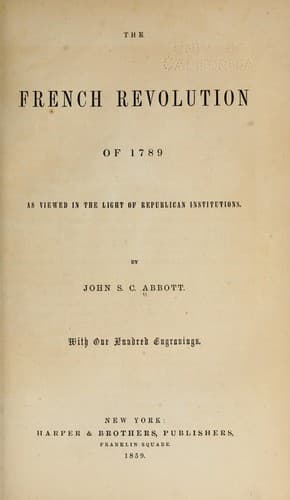
The French Revolution of 1789, as Viewed in the Light of Republican InstitutionsAbbott, John S. C. (John Stevens Cabot)
History
The French Revolution of 1789, as Viewed in the Light of Republican Institutions
Abbott, John S. C. (John Stevens Cabot)
France -- History -- Revolution, 1789-1799
The grand gala days, in the Field of Mars, celebrating the formation of
the Constitution, soon passed. The twenty thousand delegates, having
been fêted even to satiety, returned to their homes; the Constituent
Assembly resumed its labors.[258] The cares and toils of life again
pressed heavily upon the tax-exhausted and impoverished millions of
France.
The Belgians, in imitation of France, had commenced a struggle for
freedom. The King of France permitted Austria to send her troops across
the French territory into Belgium to crush the patriots. Many of the
most influential of the opponents of the Revolution were still leaving
France and uniting with the armed emigrants on the frontiers. England,
Austria, Sardinia, and Prussia were manifestly forming an alliance to
punish the French patriots, and to restore the tyranny of the execrable
old régime. The court, emboldened by these proceedings, were boasting
of the swift destruction which was to overwhelm the advocates of
reform, and commenced a prosecution of Mirabeau, the Duke of Orleans,
and others of the popular party, for instigating the movement of
the 5th and 6th of October, when the royal family were taken from
Versailles to Paris. These movements created much alarm, and even the
royal troops at Metz and Nancy, who were mostly composed of Swiss and
Germans, fraternized with the populace.
A new issue of eight hundred millions of bonds or _assignats_ was
decreed, which quite abundantly replenished the treasury. There was
never a paper currency created upon so valuable a pledge, or sustained
by security more ample and undoubted. The assignats represented the
whole public domain, and could at any time be exchanged for the most
valuable landed property. Still, Talleyrand with singular precision
predicted the confusion which eventually resulted from these issues.
In the majestic march of events, Necker had for some time been passing
into oblivion. The king had been forced to recall him. Hated by the
court, neglected by the Assembly, forgotten by the people, he soon
found his situation insupportable, and, sending in his resignation,
retired to Switzerland, from which safe retreat he watched the
terrific gatherings of the revolutionary storm.
Public-domain text, read in full here on John Shaqi.
Reviews
Reviews
No reviews yet
Be the first to share your thoughts on this work.
Elsewhere in the archive
Join the Discussion
Join the discussion
Sign in to leave a comment or review.
Sign InorCreate an account