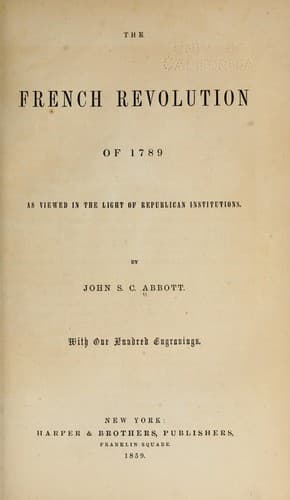
The French Revolution of 1789, as Viewed in the Light of Republican InstitutionsAbbott, John S. C. (John Stevens Cabot)
History
The French Revolution of 1789, as Viewed in the Light of Republican Institutions
Abbott, John S. C. (John Stevens Cabot)
France -- History -- Revolution, 1789-1799
Civil war was sure to break out the moment the court could obtain
possession of the person of the king. The pliant nature of the monarch
would immediately yield to the influences which surrounded him, and the
court, under such circumstances, could find no difficulty in inducing
him to sanction any acts of violence to regain their power. But while
the king was in Paris, in the hands of the Assembly, he would sanction
the decrees of the Assembly, and thus the aristocrats could not wage
war against the patriots without at the same time waging war against
the king. Foreign monarchies could not be induced to take this step.
Thus the retention of the king was peace; his escape, civil war.
The court were plotting innumerable plans to effect his escape. La
Fayette, at the head of the National Guard, was fully awake to the
responsibility of guarding him with the utmost vigilance. The king was
apparently left at perfect liberty, but he was continually watched.
The queen was exceedingly anxious for flight. The king was ever
vacillating, but generally, influenced by such advisers as Mirabeau
and La Fayette, inclined to accept the Revolution. He was also haunted
with the idea that his cousin, the Duke of Orleans, wished to frighten
him into flight, that the Assembly might declare the throne vacant, and
place the sceptre in the duke's hand as the sworn friend and supporter
of the Revolution.
Mirabeau had commenced his career as one of the most ardent
advocates of reform, but he now wished to arrest the progress of the
revolutionary chariot, as he affirmed that it had passed beyond its
proper goal. His course was attributed by some to bribery on the part
of the court. His friends say that he was only influenced by his own
patriotic intelligence. At St. Cloud there is a retired summer-house,
embowered in foliage, at the summit of a hill which crowns the highest
part of the park. The queen appointed an interview with Mirabeau at
this secluded spot.
The statesman of gigantic genius, who seemed to hold in his hand
the destinies of France, left Paris on horseback one evening, under
pretense of visiting a friend. Avoiding observation, he turned aside
into a by-path until he reached a back gate of the park. Here he
was met in the dark by a nobleman, who conducted him to the retreat
of the queen, who was waiting to receive him. His constitution was
already undermined by dissipation and unintermitted labors. His cheeks
were sunken, his eyes inflamed, his complexion sallow, and a flabby
corpulency announced the ravages of disease; but, notwithstanding all
these defects, his genial spirit and courtly bearing made him one of
the most fascinating of men.[259]
Public-domain text, read in full here on John Shaqi.
Reviews
Reviews
No reviews yet
Be the first to share your thoughts on this work.
Elsewhere in the archive
Join the Discussion
Join the discussion
Sign in to leave a comment or review.
Sign InorCreate an account