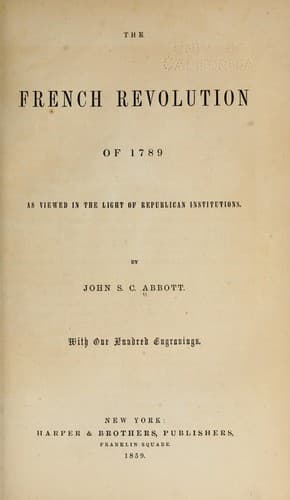
The French Revolution of 1789, as Viewed in the Light of Republican InstitutionsAbbott, John S. C. (John Stevens Cabot)
History
The French Revolution of 1789, as Viewed in the Light of Republican Institutions
Abbott, John S. C. (John Stevens Cabot)
France -- History -- Revolution, 1789-1799
The queen was then thirty-five years of age. Care and grief had sadly
marred her marvelous beauty. Her proud spirit was chagrined in being
compelled to look for support to one of the leaders of the people. But
little is known respecting what passed at this private interview. At
its close Mirabeau said to the queen,
"Madam, when your august mother admitted one of her subjects to the
honor of her presence, she never dismissed him without allowing him to
kiss her hand."
The queen, responding to the gallantry, graciously presented her hand.
Mirabeau, bowing profoundly, kissed it, and then, raising his head,
said proudly,
"Madam, the monarchy is saved."[260]
Suddenly Mirabeau became rich, set up a carriage, furnished his house
sumptuously, and gave magnificent entertainments. He immediately
commenced a course of cautious but vigorous measures to overthrow the
Constitution and establish one less democratic, which should give more
stability and efficiency to the royal power. He affirmed that this was
essential to the peace and prosperity of France, and that, instead of
being bought over by the court, he had bought the court over to his
views.
"But suppose the court refuses," said one of his friends, "to adopt
your plans?"
"They have promised me every thing," Mirabeau replied.
"But suppose they should not keep their word?" it was rejoined.
"Then," said Mirabeau, "I will overthrow the throne and establish a
republic."
It can hardly be denied that the Constitution was too democratic for a
monarchy and hardly democratic enough for a republic. In the natural
course of events public opinion would sway either to strengthening
the throne or to diminish still more its prerogatives. There were now
four parties in France. The first consisted of the old aristocratic
classes of the clergy and the nobles, now mostly emigrants, and busy
in effecting a coalition of surrounding monarchies to quell the
Revolution, and by fire and sword to reinstate the rejected despotism
of the Bourbons.
The second class was composed of the king and Mirabeau, with the queen
reluctantly assenting to its principles, and others of the nobles
and priests who were disposed, some from choice and others from the
consciousness of necessity, partially to accept the Revolution. They
were willing to adopt a constitution which should seriously limit
the old prerogatives of the crown. But they wished to repudiate the
constitution now adopted, and to form one less democratic, which would
still grant many prerogatives to the king.
Public-domain text, read in full here on John Shaqi.
Reviews
Reviews
No reviews yet
Be the first to share your thoughts on this work.
Elsewhere in the archive
Join the Discussion
Join the discussion
Sign in to leave a comment or review.
Sign InorCreate an account