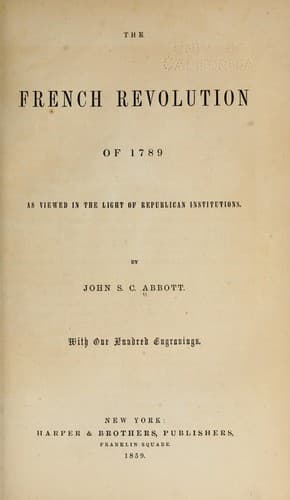
The French Revolution of 1789, as Viewed in the Light of Republican InstitutionsAbbott, John S. C. (John Stevens Cabot)
History
The French Revolution of 1789, as Viewed in the Light of Republican Institutions
Abbott, John S. C. (John Stevens Cabot)
France -- History -- Revolution, 1789-1799
The third party consisted of the great majority of the Assembly, headed
by sincere and guileless patriots like La Fayette, and sustained
probably by the great majority of the purest and best men in the
kingdom, who were in favor of the constitution which the nation had
accepted. While they did not regard it as perfect, they felt that it
was a noble advance in the right direction, and that the salvation
of the liberties of France now depended upon allegiance to this
constitution.
There was a fourth class, restless, tumultuous, uninformed, composed of
the lowest portion of the populace, who could ever be roused to phrensy
by the cry of "Aristocracy," who were ripe for any deeds of violence,
and who regarded that firmness of law which protected order, property,
and life as tyranny. They occupied the lowest possible platform of
democracy.
Such was the condition of France as the Constituent Assembly now
endeavored to consolidate the new institutions and to bring harmony
from the chaos into which the nation had been plunged. While in these
circumstances of unparalleled peril, combined Europe was watching for
an opportunity to pounce upon the distracted nation.
All public functionaries were required to take oath to the new
constitution. The clergy, as bound by the laws of the Romish Church,
appealed to the Pope for instructions. At the same time the opposing
bishops and nobles wrote to the Pope urging him to withhold his
assent.[261] The king had sanctioned the decrees. The Pope, under
various pretexts, postponed an answer. Many of the bishops and curates
consequently refused to take the oath. The Assembly was not disposed
to wait for the decision of a foreign potentate, and, accepting those
bishops and curates who took the oath, immediately nominated new
bishops and curates to take the place of those who refused. Justly
and frankly the Assembly declared that it wished to do no violence to
conscience, but that it could not appoint as public functionaries those
men who refused to take the oath of allegiance to the Constitution
of the kingdom. This increased exasperation, and enabled many of the
bishops to appeal to the fanatic populace to rise in defense of the
endangered Church.
Public-domain text, read in full here on John Shaqi.
Reviews
Reviews
No reviews yet
Be the first to share your thoughts on this work.
Elsewhere in the archive
Join the Discussion
Join the discussion
Sign in to leave a comment or review.
Sign InorCreate an account