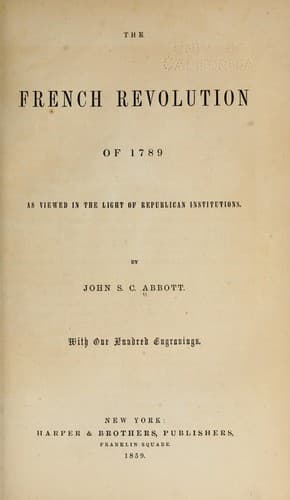
The French Revolution of 1789, as Viewed in the Light of Republican InstitutionsAbbott, John S. C. (John Stevens Cabot)
History
The French Revolution of 1789, as Viewed in the Light of Republican Institutions
Abbott, John S. C. (John Stevens Cabot)
France -- History -- Revolution, 1789-1799
The emigrants now made a general rendezvous at Coblentz, in the
territory of the Elector of Treves, and at other points of the
frontier.[262] These men, composing what was called the court,
consisted mainly of the higher nobles who had long been pampered with
the favors of the monarchy, and who looked with contempt upon the
nobles of the rural districts. Haughty, dissolute, and frivolous, they
scorned any appeal to the popular arm, even to popular fanaticism for
support. The only recourse to which they would condescend were the
armies of England, Austria, and Prussia. The rural nobles, on the
other hand, and the rural bishops, were secretly organizing their
friends within the kingdom to fall fiercely in civil war upon the
patriots so soon as the solid battalions of the allies should cross the
frontiers.[263]
In this state of things the king's aunts decided to leave France.
They had proceeded in their carriage on the way to Rome as far as
Arnay-le-Duc, when they were arrested. The feverish state of the public
mind led to suspicions that their emigration might accelerate impending
perils. The Assembly took the matter into deliberation whether the
ladies should be permitted to depart. The question was settled by a
keen sally of Menou.
[Illustration: MOB OPPOSING THE FLIGHT OF THE KING'S AUNTS.]
"All Europe," said he, "will be astonished to learn that a great
Assembly has spent several days in deciding whether two old ladies
shall hear mass at Paris or at Rome."
The worthy ladies continued the journey without interruption. The
king's next elder brother, usually called Monsieur, subsequently Louis
XVIII., remained with the king in Paris. The next brother, however, the
Count d'Artois, subsequently Charles X., was actively participating
with the emigrants at Coblentz. The very difficult question respecting
emigration was now brought forward in the Assembly. It seemed to be a
gross act of tyranny to prohibit French citizens from withdrawing from
or entering France at their pleasure. On the other hand the enemies
of regenerated France were daily leaving the kingdom with all the
resources they could collect; and from the frontier, where they were
plotting foreign and civil war, they were continually entering the
kingdom to make preparations for the invasion.
Mirabeau, who was at this time conspiring for the escape of the king,
with his accustomed vehemence and his overpowering audacity, opposed
any law against emigration.[264]
Public-domain text, read in full here on John Shaqi.
Reviews
Reviews
No reviews yet
Be the first to share your thoughts on this work.
Elsewhere in the archive
Join the Discussion
Join the discussion
Sign in to leave a comment or review.
Sign InorCreate an account