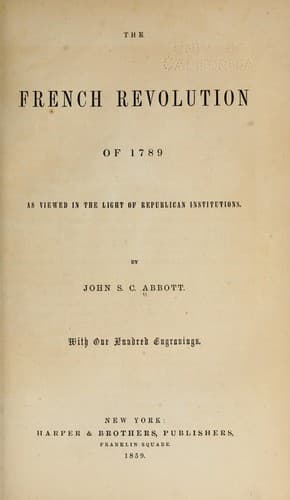
The French Revolution of 1789, as Viewed in the Light of Republican InstitutionsAbbott, John S. C. (John Stevens Cabot)
History
The French Revolution of 1789, as Viewed in the Light of Republican Institutions
Abbott, John S. C. (John Stevens Cabot)
France -- History -- Revolution, 1789-1799
[Footnote 261: Thiers, vol. i., p. 166. Ferrières, t. ii., p. 198.]
[Footnote 262: "Many of the emigrants had joined the army in a state
of complete destitution. Others were spending improvidently the last
relics of their fortunes. All were in good spirits, for the camp life
was free and joyous. They confidently believed that the end of autumn
would find them restored to their splendid homes, to their groves, to
their forests, and to their dove-cots."--_Chateaubriand's Memoirs of
the Duke de Berri._]
[Footnote 263: See Recueil de divers Ecrits relatif à la Revolution, p.
62; also Chateaubriand's Memoirs of the Duke de Berri.
In reference to England Michelet remarks, with much truth: "The
first power is aristocracy, the second aristocracy, and the third
aristocracy. This aristocracy goes on incessantly recruiting its body
with all those who grow rich. To be rich in order to be noble is the
absorbing thought of the Englishman. Property, specially territorial
and feudal, is the religion of the country."--_Michelet's French
Revolution_, p. 432.]
[Footnote 264: "The meeting ended at half past five, and Mirabeau went
to the house of his sister, his intimate and dear confidante, and said
to her, 'I have pronounced my death-warrant. It is now all over with
me, for they will kill me.'"--_Michelet_, p. 461.]
[Footnote 265: The peculiar character of Mirabeau is illustrated by
the following well-authenticated anecdote. He was, on one occasion,
reading a report to the Assembly upon some riots in Marseilles, which
he affirmed were fomented by the partisans of the court. He was
incessantly interrupted by the aristocratic party with such abusive
epithets as "calumniator, liar, assassin, scoundrel." He stopped
a moment, looked at them with an imperturbable smile, and, in his
most honeyed tones, said, "Gentlemen, I wait till these amenities be
exhausted."--_Dumont, Souvenirs_, p. 278.]
[Footnote 266: The English _people_ were at this time generally in
sympathy with the Revolution. The aristocratic _government_ of England
was in deadly hostility to it. In 1792, Samuel Taylor Coleridge, then
head scholar in Jesus College, Cambridge, wrote an Ode to France,
commencing with the words,
"When France, in wrath, her giant limbs upreared,
And, with that oath which smote air, earth, and sea,
Stamped her strong foot, and said she would be free,
Bear witness for me how I hoped and feared."
In consequence of this ode, and his avowed attachment to the
principles of the Revolution, he became so obnoxious to his superiors
that he was constrained to leave the college abruptly, without a
degree.--_Cyclopædia of English Literature, Article S.T. Coleridge._]
Public-domain text, read in full here on John Shaqi.
Reviews
Reviews
No reviews yet
Be the first to share your thoughts on this work.
Elsewhere in the archive
Join the Discussion
Join the discussion
Sign in to leave a comment or review.
Sign InorCreate an account