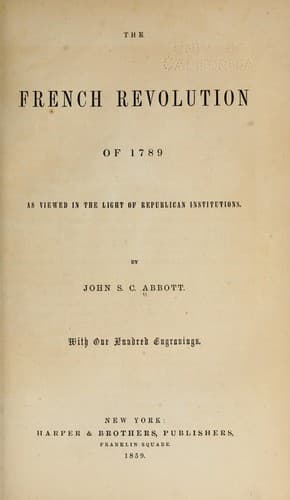
The French Revolution of 1789, as Viewed in the Light of Republican InstitutionsAbbott, John S. C. (John Stevens Cabot)
History
The French Revolution of 1789, as Viewed in the Light of Republican Institutions
Abbott, John S. C. (John Stevens Cabot)
France -- History -- Revolution, 1789-1799
[Footnote 267: M. Thiers, in the impetuosity of his narrative, is not
always accurate in details. He gives the 20th of April as the date of
Mirabeau's death. Mignet assigns it to the 2d of March. Nearly all
other authorities agree upon the 2d of April. It is indeed wonderful
that upon such a subject there should be such a diversity of statement.
The event at the time was deemed so momentous, that the Jacobin Club
voted that the anniversary of his death should, through all future
time, be celebrated with funereal pomp.]
[Footnote 268: Mirabeau claims, and his friends claim for him, and
probably with justice, that he wished to be the mediator between the
Revolution and the monarchy--to save royalty and liberty, believing
that, under the circumstances, royalty was essential to liberty. But
the folly of the court thwarted every endeavor. They would not accede
to any measure of justice and moderation. The court wished only to make
him unpopular. Mirabeau saw his position, from which no struggles could
extricate him, and he died of disappointment and grief. Had he not then
died, he would, in a few months, have inevitably perished upon the
scaffold. See _Mémoires de Mirabeau_, vol. viii.]
[Footnote 269: Bertrand de Moleville.]
[Footnote 270: Mignet, p. 101. Villiaumé, p. 91.]
[Footnote 271: Fox and others of the most illustrious of the English
commoners had in the parliament expressed their sympathy for the French
patriots. A very strenuous effort was made to unite the Whig party
in opposition to liberty in France. A meeting was held at Burlington
House. Mr. Burke was the organ of the aristocracy. The animated
discussion was continued from ten o'clock at night until three in the
morning. But the differences of opinion were found irreconcilable,
and only resulted in the permanent alienation of Fox and Burke.--_See
Lectures on the French Revolution, by Prof. Wm. Smyth_, vol. i., p.
84.]
La Fayette, to whom the whole business was intrusted, oppressed with
the responsibility of his office, was continually, by night and by day,
visiting the posts. To the officers who had charge of the night-watch
he had given secret orders that the king was not to be permitted to
leave the palace after midnight. Thus the king was truly a prisoner,
and he was fully conscious of it, though every possible effort was
adopted to conceal from him the humiliating fact.
Public-domain text, read in full here on John Shaqi.
Reviews
Reviews
No reviews yet
Be the first to share your thoughts on this work.
Elsewhere in the archive
Join the Discussion
Join the discussion
Sign in to leave a comment or review.
Sign InorCreate an account