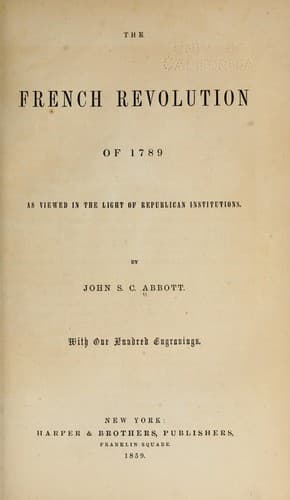
The French Revolution of 1789, as Viewed in the Light of Republican InstitutionsAbbott, John S. C. (John Stevens Cabot)
History
The French Revolution of 1789, as Viewed in the Light of Republican Institutions
Abbott, John S. C. (John Stevens Cabot)
France -- History -- Revolution, 1789-1799
M. Bouillé and the queen were compelled to yield to the whims of the
king, and to adopt measures which threatened to frustrate the plan. The
king insisted upon having an immense carriage constructed which could
take the whole party, though the unusual appearance of the carriage
would instantly attract all eyes; he insisted upon traveling a very
unfrequented route, which would excite the curiosity of every one who
should see the carriage pass; he insisted upon stationing military
detachments along the route, though Bouillé urged that such detachments
if small could render no service, and if large would excite suspicion;
he insisted upon taking the governess of the children, because the
governess said that she loved the children too much to be separated
from them, though Bouillé urged that instead of the incumbrance of a
governess they should take in the carriage an officer accustomed to
traveling, and who could aid in any unexpected emergency. The king,
though fickle as the wind upon questions of great moment, was, like all
weak men, inflexible upon trifles.[273]
At midnight of the 20th of June, the king, the queen, Madame Elizabeth,
the sister of the king, the two royal children, and Madame Tourzel
their governess, carefully disguised themselves in one of the interior
rooms of the Tuileries. Creeping cautiously down, in three successive
parties, an obscure flight of stairs, and emerging by a gate which
was contrived to be left unguarded, the fugitives, mingling with the
groups of people who ever at that time were leaving the chateau,
crossed the Carrousel, and, taking different streets, groped along
through the darkness until they all met on the Quai des Théatins, where
two hackney-coaches awaited them. In breathless silence they took
their seats. The Count de Fersen, a Prussian noble, young, handsome,
enthusiastic, who was inspired with a chivalric admiration of Marie
Antoinette, had made all the arrangements for the escape from the
city. Disguised as a coachman, he conducted the king, who led the
young dauphin by the hand. The count immediately mounted the box of
the coach which contained the royal family, and drove rapidly some
twelve miles to the little town of Bondy, where the capacious carriage
constructed for the king was waiting before the door of an Englishman,
Mr. Crawford. At the same hour in a similar manner the king's brother,
Monsieur the Count of Provence, subsequently Louis XVIII., left the
Palace of the Luxembourg, and with his family traveled all night toward
Flanders, where he crossed the frontiers in safety.
Public-domain text, read in full here on John Shaqi.
Reviews
Reviews
No reviews yet
Be the first to share your thoughts on this work.
Elsewhere in the archive
Join the Discussion
Join the discussion
Sign in to leave a comment or review.
Sign InorCreate an account