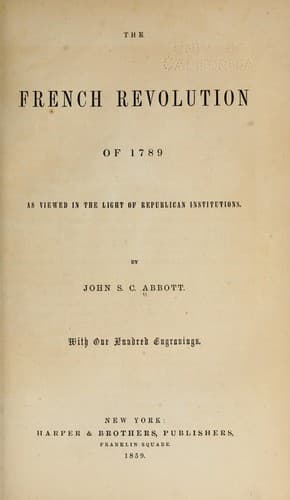
The French Revolution of 1789, as Viewed in the Light of Republican InstitutionsAbbott, John S. C. (John Stevens Cabot)
History
The French Revolution of 1789, as Viewed in the Light of Republican Institutions
Abbott, John S. C. (John Stevens Cabot)
France -- History -- Revolution, 1789-1799
At Bondy the king, the queen, Madame Elizabeth, the two children,
Maria Theresa being about ten years of age and Louis seven, with
their governess, took their seats in the large carriage. One of the
body-guard of the king, disguised as a servant, sat on the box, and
another, as footman, sat behind. M. de Vallory rode on horseback, that
he might gallop forward and order the relays of horses. The waiting
women of the queen, who, by the strangest infatuation, had been
included in the party, took the other carriage.
The Marquis of Bouillé, an energetic, heroic man, finding that he could
not control the arrangements of the king, did every thing in his power
to avert the suspicion which the strange-looking cortège would be
likely to excite. He had a passport prepared, in which the governess
was represented as a German baroness, Madame de Korff, traveling
with her two children. The king was her valet-de-chambre, the queen
her waiting-maid. The proverbial wealth of the German barons and the
peculiar style of the equipage to which they were accustomed happily
favored this idea.[274]
The morning was just beginning to dawn as Count Fersen kissed the
hands of the king and queen and left them to prosecute their perilous
journey, while he took flight for the frontier through Flanders. The
coach was drawn by six horses, who were driven at the utmost speed,
relays of horses having been established at short stages. The sun at
length rose bright and cheerful. The country was smiling in all the
verdure of blooming June. Every revolution of the wheels was bearing
them farther from Paris. It was hardly possible that their flight
could be discovered until a late hour in the morning. There were no
telegraphs in those days to send intelligence with lightning speed
to arrest their flight. Having six or eight hours the start of their
pursuers, and being abundantly supplied with fresh horses, escape
seemed now almost certain. Hope began to cheer their hearts.
Some slight interruptions had retarded their progress, and it was about
three o'clock in the afternoon when they entered Chalons, some ninety
miles from Paris. The queen, with an exultant smile, exclaimed, "All
goes well. If we were to have been stopped at all it would have been
before now."
At Chalons they exchanged horses. The king now felt that he was safe,
for the Marquis of Bouillé had posted detachments of troops at every
important point between Chalons and Montmedy. With characteristic
imprudence, as the carriage was surrounded with idlers at Chalons, the
king put his head out of the window, showing his well-known face to the
crowd. The postmaster instantly recognized the king, but, being himself
an ardent Royalist, divulged not his secret, but aided in putting in
the fresh horses, and ordered the postillions to drive on.
Public-domain text, read in full here on John Shaqi.
Reviews
Reviews
No reviews yet
Be the first to share your thoughts on this work.
Elsewhere in the archive
Join the Discussion
Join the discussion
Sign in to leave a comment or review.
Sign InorCreate an account