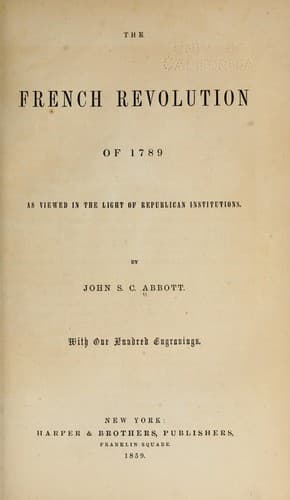
The French Revolution of 1789, as Viewed in the Light of Republican InstitutionsAbbott, John S. C. (John Stevens Cabot)
History
The French Revolution of 1789, as Viewed in the Light of Republican Institutions
Abbott, John S. C. (John Stevens Cabot)
France -- History -- Revolution, 1789-1799
About ten miles from Chalons is the bridge of Sommeville, which crosses
a narrow stream, where the Duke of Choiseul and M. Goguelat were
stationed with fifty hussars. They were to secure the king's passage,
and then to remain and block up the road against all pursuers. Faithful
to the plan, they were at the bridge, with the mounted hussars, at the
appointed hour. The strange assemblage of a military force at that spot
excited the curiosity of the peasants, and a great crowd was gathered.
Every mind throughout France was then in a very sensitive state. The
crowd increased, and in the adjoining villages the alarm-bells were
beginning to ring. As the royal carriages did not appear for five or
six hours later than they were expected, the Duke of Choiseul, to
appease the ferment, left the spot, and the people then dispersed.
Soon after the detachment had left the king arrived, and was surprised
to find no troops. It was then between four and five o'clock in the
evening. In great perplexity and anxiety he drove rapidly on two hours
farther to St. Menehould, where he was to find another detachment of
troops; but the Duke of Choiseul had sent forward to St. Menehould and
Chalons, informing the detachments there that he had waited six hours
for the arrival of the king; that the plan had probably miscarried;
that excitement was rapidly rising among the people; and that the
detachments had better retire.
The king, unaware of all this, was astonished and bewildered in still
finding no troops, and naturally, but imprudently, again looked out of
the window. The excited crowd which was gathered around the carriages
suspected that they contained the royal family. A young man named
Drouet, son of the postmaster, instantly recognized the king, from
his resemblance to the imprint on the coins in circulation. Without
communicating his discovery to any one, he mounted a horse, and, taking
a cross road, galloped some twelve or fifteen miles to Varennes, to
inform the municipality and cause the arrest of the party.
FOOTNOTES:
[Footnote 272: "The princes," writes M. Fromont, "conceived the plan
of forming legions of all the loyal subjects of the king. Desiring
to be at the head of those Royalists whom I had commanded in 1789, I
wrote to Count d'Artois, begging his royal highness to grant me the
commission of colonel, worded so that every Royalist who would raise a
legion might hope for a like favor. The members of his council thought
it so strange that a _commoner_ should aspire to a military commission,
that one of them said to me angrily, 'Why did you not ask for a
bishopric?'"--_Recueil de divers Ecrits relatifs à la Revolution_, p.
62.]
Public-domain text, read in full here on John Shaqi.
Reviews
Reviews
No reviews yet
Be the first to share your thoughts on this work.
Elsewhere in the archive
Join the Discussion
Join the discussion
Sign in to leave a comment or review.
Sign InorCreate an account