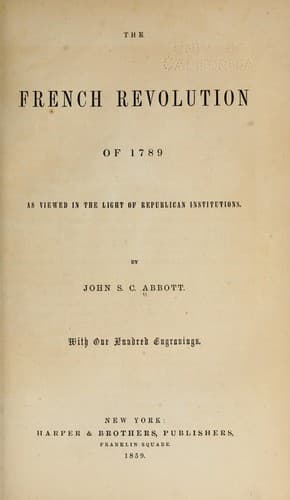
The French Revolution of 1789, as Viewed in the Light of Republican InstitutionsAbbott, John S. C. (John Stevens Cabot)
History
The French Revolution of 1789, as Viewed in the Light of Republican Institutions
Abbott, John S. C. (John Stevens Cabot)
France -- History -- Revolution, 1789-1799
[Footnote 273: "What grieves us, moreover, among other things, in
this journey to Varennes, and lessens the idea we would like to
entertain of the king's goodness of heart, is the indifference with
which he sacrificed, by his departure, and abandoned to death men
who were sincerely attached to him. By the force of circumstances La
Fayette found himself to be the involuntary guardian of the king, and
responsible to the nation for his person. He had shown in various ways,
and sometimes even in compromising the Revolution, that he desired,
beyond every thing else, the restoration of the kingly power, as the
guarantee of order and tranquillity. There was every reason to suppose
that, at the startling news of the king's departure, La Fayette would
be torn to pieces.
"La Fayette, receiving warnings from several quarters, would believe
nobody but the king himself. He went to him and asked him whether there
was any truth in the reports. Louis XVI. gave such a decided, simple
answer, and in such a good-natured manner, that La Fayette went away
completely satisfied, and it was merely to calm the anxiety of the
public that he doubled his guard."--_Michelet_, p. 573.]
[Footnote 274: The passport was made out as follows: "De par le roi.
Mandons de laisser passer Madame le Baron de Korff, se rendant à
Franckfort avec ses deux enfants, une femme de chambre, un valet de
chambre, et trois domestiques."]
CHAPTER XXI.
ARREST OF THE ROYAL FUGITIVES.
Arrival at Varennes.--The Party arrested.--Personal Appearance of the
King.--The Guards fraternize with the People.--Indignation of the
Crowd.--The Captives compelled to return to Paris.--Dismay of M. de
Bouillé.--Excitement in Paris.--The Mob ransack the Tuileries.--Acts
of the Assembly.--Decisive Action of La Fayette.--Proclamation of the
King.--The Jacobin Club.--Unanimity of France.
The carriages were driven rapidly forward, while the royal family sat
perplexed and silent, yet quite unprepared for the doom which was
impending. An hour's drive brought them to Clermont. Here the king
found two squadrons of horse, under Count de Dumas. But the detachments
of dragoons moving to and fro had excited suspicion, and the populace
of Clermont had been roused, and gathered alarmingly around the
carriages.
Public-domain text, read in full here on John Shaqi.
Reviews
Reviews
No reviews yet
Be the first to share your thoughts on this work.
Elsewhere in the archive
Join the Discussion
Join the discussion
Sign in to leave a comment or review.
Sign InorCreate an account