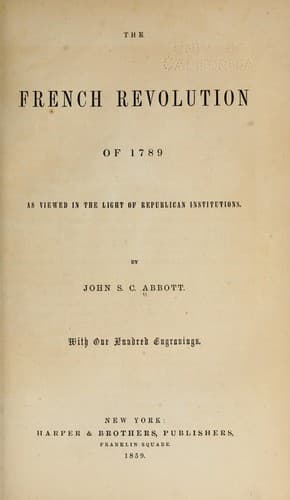
The French Revolution of 1789, as Viewed in the Light of Republican InstitutionsAbbott, John S. C. (John Stevens Cabot)
History
The French Revolution of 1789, as Viewed in the Light of Republican Institutions
Abbott, John S. C. (John Stevens Cabot)
France -- History -- Revolution, 1789-1799
Anne of Austria held the regency for nine years, until her son, having
attained the age of fourteen, had completed his minority and assumed
the crown. Under this powerful prince the monarchy of France, as an
unlimited despotism, became firmly established. The nobles, though
deprived of all political power, were invested with such enormous
privileges, enabling them to revel in wealth and luxury, that they
were ever ready to unite with the king in quelling all uprising of the
people, who were equally robbed by both monarch and noble. During the
long reign of this monarch, for Louis XIV. sat upon the throne for
seventy-two years, if we consider his reign to have commenced when he
was proclaimed king upon the death of his father, France made vast
strides in power, wealth, and splendor. Palaces arose almost outvying
the dreams of an Oriental imagination. The saloons of Marly, the
Tuileries, the Louvre, and Versailles, were brilliant with a splendor,
and polluted with debaucheries, which Babylon, in its most festering
corruption, could not have rivaled. The nobles, almost entirely
surrendered to enervating indulgence, were incapacitated for any post
which required intellectual activity and energy. Hence originated a
class of men who became teachers, editors, scientific and literary
writers, jurists, and professional men. In the progress of commerce and
manufactures, wealth increased with this class, and the king, to raise
money, would often sell, at an enormous price, a title of nobility to
some enriched tradesman.
A numerous and powerful middle class, rich and highly educated, was
thus gradually formed, who had emerged from the people, and whose
sympathies were entirely with them. The nobles looked upon all these,
however opulent, or cultivated in mind, or polished in manners, with
contempt, as low-born. They refused all social intercourse with them,
regarding them as a degraded caste. They looked with even peculiar
contempt upon those who had purchased titles of nobility.
They drew a broad line of distinction between the _nobles_ and the
_ennobled_. The hereditary aristocracy, proud of a lineage which could
be traced through a hundred generations, and which was lost in the haze
of antiquity, exclaimed with pride, instinct to the human heart:
"You may give a lucky tradesman, in exchange for money, a title of
nobility, but you can not thus make him a nobleman; you can not thus
constitute him a lineal descendant of the old Frank barons; you can not
thus constitute him a Lorraine, a Montmorency, a Rohan. God alone can
create a nobleman."
Public-domain text, read in full here on John Shaqi.
Reviews
Reviews
No reviews yet
Be the first to share your thoughts on this work.
Join the Discussion
Join the discussion
Sign in to leave a comment or review.
Sign InorCreate an account