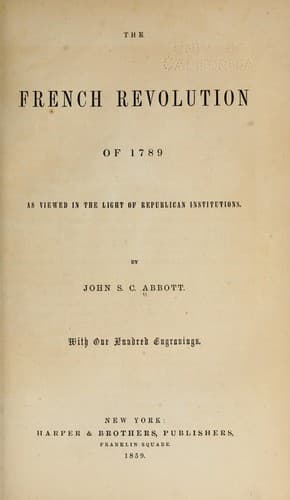
The French Revolution of 1789, as Viewed in the Light of Republican InstitutionsAbbott, John S. C. (John Stevens Cabot)
History
The French Revolution of 1789, as Viewed in the Light of Republican Institutions
Abbott, John S. C. (John Stevens Cabot)
France -- History -- Revolution, 1789-1799
Thus they regarded a man who had been ennobled by a royal decree, or
who had descended from a father or a grandfather thus ennobled, as a
new man, an upstart, one hardly redeemed from contempt. The doors of
their saloons were closed against him, and he was every where exposed
to mortifying neglect. A noble whose lineage could be traced for two or
three centuries, but whose origin was still _distinctly defined_, was
considered as perhaps belonging to the aristocratic calendar, though of
low estate. The fact that the time once was, when his ancestors were
known to be low-born, was a damaging fact, which no subsequent ages of
nobility could entirely efface. He only was the true noble, the origin
of whose nobility was lost in the depths of the past, the line of whose
ancestry ran so far back into the obscurity of by-gone ages that no one
could tell when it commenced.
It has generally been said that there were three estates in the
realm; the clergy composing the first, the nobles the second, and the
people the third. But the higher class of the clergy, luxuriating
in the bishoprics and the abbacies, with their rich emoluments,
were the sons of the nobility, and shared in all the privileges and
popular odium pertaining to that class. The lower clergy, devoted to
apostolic labors and poverty, belonged to the people, and were with
them in all their sympathies. Thus there were in reality but two
classes, the _privileged_ and the _unprivileged_, the _patrician_ and
the _plebeian_, the _tax payer_ and the _tax receiver_. The castle,
whether baronial or monastic in its architecture, was the emblem of
the one, the thatched cottage the symbol of the other. Louis XIV., as
Madame de Maintenon testifies, was _shocked_ to learn that Jesus Christ
associated with the poor and the humble, and conversed freely with them.
Public-domain text, read in full here on John Shaqi.
Reviews
Reviews
No reviews yet
Be the first to share your thoughts on this work.
Join the Discussion
Join the discussion
Sign in to leave a comment or review.
Sign InorCreate an account