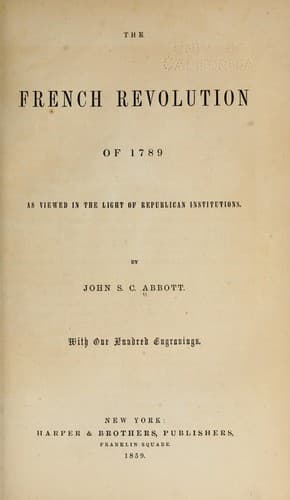
The French Revolution of 1789, as Viewed in the Light of Republican InstitutionsAbbott, John S. C. (John Stevens Cabot)
History
The French Revolution of 1789, as Viewed in the Light of Republican Institutions
Abbott, John S. C. (John Stevens Cabot)
France -- History -- Revolution, 1789-1799
In the midst of these stormy scenes the Assembly voted to remove
the remains of Voltaire, which had slumbered for thirteen years in
the obscure abbey of Scellières in Champagne, to the Pantheon in
Paris. On the 11th of July his coffin was received with great pomp
at the barriers, and conducted to a pedestal on the ancient site of
the Bastille, constructed from one of the foundation-stones of the
fortress. Voltaire had once been imprisoned in that gloomy citadel.
Upon the pedestal which supported the coffin were engraved the words,
"Receive on this spot, where despotism once fettered thee, the honors
decreed thee by thy country."
The next day a brilliant sun invited the whole population of Paris to
the fête. The car which bore the coffin to the Pantheon was drawn by
twelve white horses, harnessed four abreast. They were very richly
caparisoned, and led by postillions in antique attire. An immense body
of cavalry headed the procession. The wail of requiems and the roar of
muffled drums blended with the booming of minute guns from the adjacent
heights. The sarcophagus was preceded, surrounded, and followed by
the National Assembly, the municipal authorities of the city, and by
deputations from all the illustrious and dignified bodies of France.
Scholars, laborers, artists, and, conspicuously, all the actors and
actresses of Paris, took part in the pageant. Arches, with garlands of
leaves and wreaths of roses, spanned the streets. Groups of beautiful
girls, dressed in white, carpeted the path with flowers. At intervals,
bands of music were placed, saluting the car as it approached with
bursts of melody. Before each of the principal theatres the procession
stopped, and a hymn was sung in commemoration of the achievements of
the great dramatist. It was ten o'clock at night before the immense
procession reached the Pantheon. The coffin was deposited between those
of Descartes and Mirabeau.
[Illustration: THE REMAINS OF VOLTAIRE TRANSFERRED TO THE PANTHEON.]
It was the pen of Voltaire which overthrew despotism in France. It was
also the pen of Voltaire which banished for so long from human hearts
thoughts of God and of future responsibility. Thus then sprung up,
in the place of the despotism he had overthrown, another despotism
a thousand fold more terrible. With consummate genius and utter
destitution of all moral principle, he was the demon of destruction,
sweeping the good and the bad alike into indiscriminate ruin. He
could fawn upon the infamous Frederic, and palliate his vices. He was
ever ready to bow the knee to the paramours of Louis XV. There was no
prostitution of genius which could cause him to blush. The venomous
spirit with which he pursued the religion of Christ is fully expressed
by his motto, "_Crush the wretch_." The genius of Voltaire induced
France to attempt to establish liberty without religion. The terrific
result will probably dissuade from any future repetition of that
experiment.
Public-domain text, read in full here on John Shaqi.
Reviews
Reviews
No reviews yet
Be the first to share your thoughts on this work.
Elsewhere in the archive
Join the Discussion
Join the discussion
Sign in to leave a comment or review.
Sign InorCreate an account