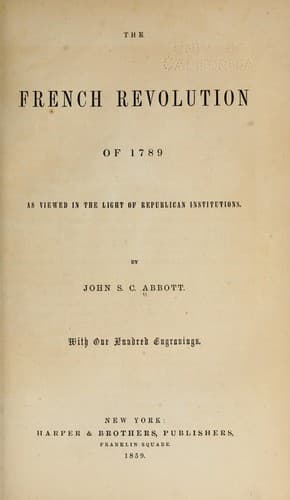
The French Revolution of 1789, as Viewed in the Light of Republican InstitutionsAbbott, John S. C. (John Stevens Cabot)
History
The French Revolution of 1789, as Viewed in the Light of Republican Institutions
Abbott, John S. C. (John Stevens Cabot)
France -- History -- Revolution, 1789-1799
The club of the Jacobins was greatly roused by the moderation of the
Assembly, and began to clamor for the entire overthrow of the monarchy
and the establishment of a republic. On the evening of the 15th of July
a meeting of the club was held at which four thousand persons were
present. It was a scene of wild enthusiasm. La Fayette, Barnave, and
others who were in favor of a constitutional monarchy were denounced
as traitors. Robespierre and Danton were the orators of the evening,
and they were greeted with thunders of applause. A petition was sent to
the Assembly, which assumed the tone of an order, demanding that the
king should be deposed as a perfidious traitor to his oaths. It was a
meeting of the mob virtually repudiating the Assembly, and assuming for
itself both legislative and executive power. The tumultuous gathering
was not dispersed until after midnight. Here originated that spirit of
lawless violence which subsequently transformed Paris into a field of
blood.
On the 16th the commissioners made their report to the Assembly on
the flight of the king. Both the commissioners and the Assembly
were disposed to be lenient. They were already very anxious in view
of popular tumult and menacing anarchy. They had still no wish to
overthrow the monarchy and establish a republic. Such a measure
would be full of danger to France in its distracted state, and would
exasperate a thousand fold the surrounding monarchies. There was no
one for whom they wished to exchange their present king. He was the
legitimate monarch, which gave him vast power over all the aristocracy
of Europe. He had sworn to defend the Constitution, and it was so
manifestly for his interest now to consent to be a constitutional
monarch that it was hoped that he would sincerely accept that popular
cause which would secure for him popular support. Though no one doubted
that it had been the intention of the vacillating monarch to throw
himself into the midst of foreign armies, and by the aid of their
artillery and swords to force the Old Régime again upon France, a very
generous report, exculpating the king from blame, was presented and
adopted.
Influenced by these views, it was argued that the king had committed
no crime. He surely had a right, if he wished, to take a journey to
Montmedy. There was no proof that he intended any thing more, he had
violated no law. The Assembly therefore decreed that "in the journey
there was nothing culpable."[288]
The Jacobin press now became very bold. "No more king," exclaimed
Brissot in the _Patriot_; "let us be Republicans. Such is the cry at
the Palais Royal, and it does not gain ground fast enough."
"No king! no protector! no regent!" shouted Fauchet in the _Bouche de
Fer_ (the Mouth of Iron).
Public-domain text, read in full here on John Shaqi.
Reviews
Reviews
No reviews yet
Be the first to share your thoughts on this work.
Elsewhere in the archive
Join the Discussion
Join the discussion
Sign in to leave a comment or review.
Sign InorCreate an account